

Your knee gave out mid-game. Or maybe it was just a wrong step on uneven ground—nothing dramatic, nothing heroic. But the pop you heard? That sound changed everything.
For thousands across the country, that moment marks the beginning of a battle most never saw coming. An ACL tear doesn’t discriminate—it strikes the weekend cricketer, the morning jogger, the college athlete chasing dreams, and the parent chasing a child across the park.
One second you’re moving freely. Next, you’re wondering if you’ll ever trust your body the same way again.
The Reality Patients Understand Only When Symptoms Escalate
An ACL tear isn’t just about a damaged ligament. It’s about lost momentum—seasons cut short, careers reconsidered, confidence shaken. It’s the fear that creeps in every time you plant your foot.
It’s the questions that haunt you at 2 AM:
- Will I recover fully?
- Will this happen again?
- Did I wait too long?
The answers matter. And they start by understanding
- What actually happened in your knee
- Why it happened
- And what real recovery
Whether you’re evaluating options with an orthopaedic specialist in Jamshedpur or elsewhere, the clarity you gain now will determine the strength you rebuild tomorrow.
This isn’t just another injury on ACL Tears: Causes, Symptoms, and Recovery Timeline. This is your turning point.
Let’s dive in.
ACL Tear Explained: Why This Injury Can Destabilise the Entire Knee
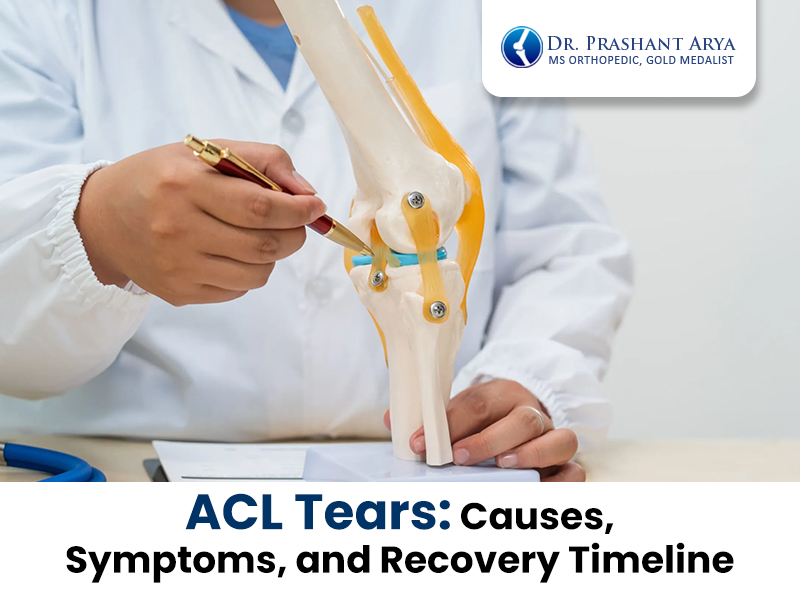
An ACL tear is a rupture of the anterior cruciate ligament, which stabilises forward movement and rotation of the knee. When torn, the knee loses mechanical control, causing instability during walking, turning, and sports and increasing the risk of cartilage and meniscal damage.
To grasp why this single ligament causes such widespread disruption, its mechanical role must be understood first.
The Mechanical Role of the ACL in Knee Stability
The ACL functions as the knee’s internal stabiliser [Source].
It prevents the shin bone from sliding forward and controls rotation during movement. Without it, the knee cannot coordinate load, balance, and direction safely.
What Fails First After an ACL Rupture
When the ACL loses its stabilising role, the impact spreads quickly beyond the ligament itself.
| What Fails First Post-ACL Rupture | What Happens Inside the Knee |
|---|---|
| Rotational Stability | Knee control during turning or pivoting movements collapses, causing sudden instability or “giving way.” |
| Muscle Coordination | A protective muscle response slows, reducing joint control and increasing the risk of repeated injury. |
| Load Distribution | Stress shifts to the cartilage and meniscus, increasing the risk of tears, wear, and long-term joint damage. |
This explains why instability defines the injury more than pain does.
Most Common ACL Injury Causes
ACL injuries usually result from sudden twisting, pivoting, rapid deceleration, or awkward landings that overload the ligament. These forces most often occur during sports, accidental falls, or road-traffic injuries, and often occur without direct contact.
Once the causes are clear, patterns begin to repeat across age groups and lifestyles.
High-speed sports expose the knee to combined forces of speed, rotation, and fatigue. When muscle timing falters, the ligament absorbs stress it was never designed to handle. This is why unresolved knee pain from a sports injury should never be ignored.
Common movement-related causes include:
| Movement Pattern | What Happens Inside the Knee | Why the ACL Fails |
| Sudden change of direction on a planted foot | The shin bone twists while the thigh stays fixed | The ACL is overloaded by rotational force |
| Improper landing from jumps | The knee collapses inward on impact | Ligament fibres stretch and tear instantly |
| Abrupt stopping while running | Forward momentum jerks the knee forward | The ACL cannot absorb sudden deceleration |
| Direct knee trauma during collisions | External force drives the knee off alignment | The ligament ruptures under impact stress |
Early ACL Tear Symptoms That People Commonly Miss?
ACL tear symptoms include a popping sensation, rapid swelling of the knee, and difficulty continuing activity. Pain may reduce within days, but persistent instability or a feeling that the knee may give way signals a structural ligament injury.
Symptoms evolve, which is why early warning signs are often misunderstood.
Immediately after injury, swelling takes centre stage
Immediately after injury, swelling becomes one of the earliest symptoms of knee ligament injury. Fluid rapidly accumulates inside the joint due to bleeding and inflammation, causing pain, stiffness, and restricted movement.
Early swelling often signals significant internal injury and requires prompt medical evaluation. Recognising instability early prevents secondary injury.
An experienced orthopaedic specialist in Jamshedpur, such as Dr Prashant Arya, evaluates knee mechanics, not just pain levels, to prevent silent progression toward cartilage wear and early arthritis.
ACL Tears: When Is Surgery the Right Choice?
Not every ACL tear requires surgery [Source]. Treatment depends on knee stability, activity level, and lifestyle demands.
Stable knees with low physical demands may be managed with rehabilitation, while ongoing instability or athletic requirements often necessitate surgical intervention. The decision is biomechanical, not emotional.
ACL tear treatment must match how the knee will be used daily. Compensation strategies may work temporarily, but unstable knees exposed to high demand almost always deteriorate without surgical stabilisation.
When ACL Reconstruction Surgery Is Recommended
ACL reconstruction surgery replaces the torn ligament with a graft to restore stability. It is advised that, when instability interferes with daily activities, work, or sports, and when repeated episodes risk further joint damage, you consult a specialist.
Once surgery is considered, recovery expectations must be grounded in biology.
Understanding ACL Ligament Recovery Timeline
ACL ligament injury recovery time spans several months and depends on treatment choice, the quality of rehabilitation, and biological healing. Pain reduction occurs early, but full strength, coordination, and stability take significantly longer to restore.
Recovery unfolds in phases, not promises
Rehabilitation rebuilds muscle balance, joint awareness, and movement control. Rushing this process increases the risk of reinjury and long-term instability, a pattern frequently observed by every orthopaedic specialist in Jamshedpur managing revision cases.
A realistic timeline helps align expectations with physiology.
| Recovery Phase | Approximate Duration |
| Swelling and motion restoration | 2–3 weeks |
| Strength and neuromuscular control | 3–4 months |
| Functional and sport readiness | 8–12 months |
Understanding Recovery Stages After ACL Reconstruction
The ACL surgery recovery timeline typically lasts 9 to 12 months. The early stages focus on swelling control and movement, followed by strength rebuilding, neuromuscular training, and a gradual return to sports once stability and control are restored.
Surgery restores structure, but recovery restores confidence.
The graft must biologically integrate before it can tolerate stress. Ignoring this timeline undermines surgical success regardless of technique.
ACL Tear Recovery: Why Physiotherapy Cannot Be Skipped
Physiotherapy after an ACL tear retrains muscle coordination, balance, and reaction time. It protects the reconstructed ligament and determines whether patients return confidently or remain hesitant and vulnerable to reinjury.
ACL Injury Treatment in Jamshedpur: Who Should You Trust With Your Knee?
ACL injuries require accurate diagnosis, personalised treatment decisions, and structured rehabilitation. Optimal outcomes depend on an experienced orthopaedic specialist who understands biomechanics, activity demands, and the long-term preservation of joints.
This is where experience changes outcomes.
Patients seeking the best orthopaedic doctor in Jamshedpur value clarity over haste. Dr Prashant Arya provides evidence-based care focused on knee longevity and functional confidence.
As a trusted orthopaedic specialist in Jamshedpur, his approach aligns treatment with each patient’s life demands rather than generic protocols.
Quick Recap: What Matters Most
ACL tears cause knee instability, swelling, and long-term joint damage if untreated. Common causes include twisting injuries and sports-related movements, and symptoms often persist as instability even after pain subsides. Treatment ranges from rehabilitation to reconstruction surgery, followed by structured physiotherapy.
Speak to Dr Prashant Arya, a leading orthopaedic specialist in Jamshedpur, without delay.
People Also Ask
How long do ACL tears take to recover?
ACL recovery usually takes 6 to 12 months, depending on injury severity, treatment type, and the quality of rehabilitation. Pain settles early, but strength, stability, and safe sports return require structured recovery.
What is a Stage 1 ACL tear?
A Stage 1 ACL tear is a mild ligament stretch without rupture. Knee stability remains intact. Most recover with rest, physiotherapy, and strengthening without surgery.
Does an ACL tear happen suddenly?
Yes. ACL tears occur during sudden twists, pivots, or awkward landings. A popping sensation and rapid swelling are common, causing immediate knee instability.
Can ACL heal in 3 months?
No. Complete ACL tears cannot heal within 3 months. Partial injuries may improve with rehabilitation, but full stability needs long-term management or reconstruction.



Leave A Comment