
Arthritis & Knee Pain Doctor in Jamshedpur
Home / Treatments / Knee / Arthritis & Knee Pain
Precise treatments for osteoarthritis and knee pain
12,000+ patients treated across orthopaedic care
14+ years of orthopaedic surgical experience
MS Orthopaedic, Gold Medalist
Fellowship in Arthroscopy and Sports Surgery
- Red Cross Bhawan, Pipe Line Road, near Old Court Road, Ambagan, Sakchi, Jamshedpur, Jharkhand 831001
Orthopaedic Treatments

What Is Arthritis?
A general term for joint diseases that cause pain, swelling, stiffness, and reduced movement, often leading to deep knee discomfort and limited mobility when the knee is affected.
Key Points To Know
| Aspect | Details |
|---|---|
| Definition | Inflammation or breakdown of cartilage and joint tissues, causing pain, stiffness, swelling, and reduced movement. |
| Types | Osteoarthritis (OA): Cartilage breakdown & Rheumatoid arthritis (RA): Autoimmune inflammation of the joints. |
| Prevalence | Over 195 million Indians—roughly one in six people—suffer from arthritis-related joint/knee pain. |
Before Treatment, Understand These First
Does cracking your knuckles cause arthritis?
No. Research finds no link between habitual popping and disease.
Can cold weather cause arthritis?
No. Atmospheric shifts may increase discomfort, but cannot cause the disease.
Does extra weight affect knee arthritis?
Yes. Extra body weight increases stress on the knees and can worsen pain and disease progression.
Is arthritis fatigue just normal tiredness?
No. Profound exhaustion can reflect ongoing immune activity and inflammation.
Can exercise worsen joint damage?
No. Appropriate movement strengthens supporting muscles and safely reduces stiffness.
Types of Arthritis
Osteoarthritis (OA)
Cartilage gradually wears down, commonly affecting knees, hips, and hands.
Rheumatoid (RA)
An autoimmune condition causing symmetrical joint inflammation, stiffness, and swelling.
Gout
Uric acid crystals accumulate inside joints, causing sudden, intense pain.
Psoriatic (PA)
An inflammatory condition affecting joints in some people with psoriasis.
Grades of Arthritis
| Grade | Description |
|---|---|
| 0 – Normal | No visible arthritis or structural joint damage. |
| 1 – Doubtful | Possible narrowing with tiny bone spurs; symptoms usually absent. |
| 2 – Mild | Definite bone spurs with possible narrowing and occasional discomfort. |
| 3 – Moderate | Multiple bone spurs, clear narrowing, cartilage damage, and frequent pain. |
| 4 – Severe | Marked joint-space loss, bone changes, severe pain, and limited mobility. |
You May Need Arthritis Treatment if You Have
- Aching or throbbing joint discomfort
- Morning stiffness or stiffness after rest
- Swelling, warmth, or joint tenderness
- Difficulty bending, straightening, or rotating
- Trouble performing everyday activities
- Popping, clicking, or grinding sounds
- Difficulty walking or climbing stairs
- Pain despite non-surgical treatment
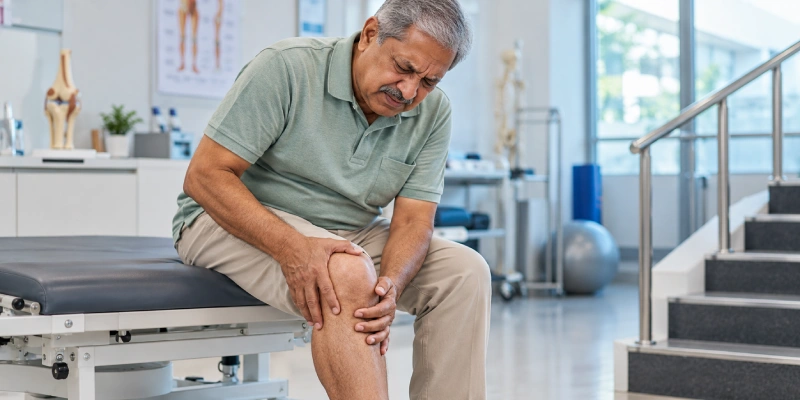
Complications if Arthritis Is Not Treated?
Permanent cartilage loss
Knee deformity
Muscle weakness and instability
Bone damage
Severe disability
Weight gain
Metabolic and heart risks
Mental health decline
Complex future surgeries
Progressive joint stiffness
Increasing dependence on support
Greater difficulty performing daily activities
Increased risk of falls
Declining quality of life
Diagnostic Tests Before Arthritis Treatment
Clinical Examination
- Joint Assessment
- Range Of Motion
- Gait Assessment
- Assessment Of Swelling And Deformity
Inflammatory & Autoimmune Blood Tests
- Erythrocyte Sedimentation Rate (ESR)
- C-Reactive Protein (CRP)
- Rheumatoid Factor (RF)
- Anti-CCP Antibody Test
- Uric Acid Test
- Antinuclear Antibody (ANA)
Imaging Tests
- X-Rays
- Weight-Bearing X-Ray
- MRI (Magnetic Resonance Imaging)
- Ultrasound
- CT Scan When Required
General Health & Pre-Surgery Tests
- Complete Blood Count
- Blood Sugar Testing
- Electrocardiogram (ECG)
- Chest X-Ray
- Urinalysis
- Urinary Infection Screening
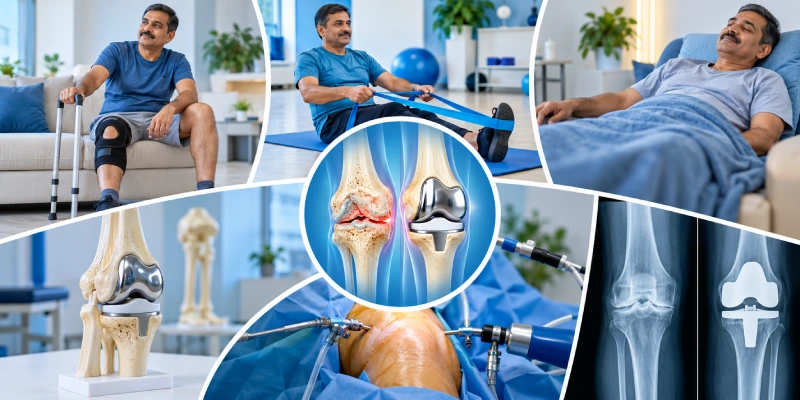
Types of Arthritis Treatment
Non-Surgical Treatment
- Medications: Relieve pain and inflammation.
- Physical therapy: Improves strength and mobility.
- Joint injections: Reduce inflammation and discomfort.
- Lifestyle changes: Reduce joint stress.
- Assistive devices: Improve stability and support.
Surgical Treatment
- Arthroscopy: Addresses selected joint problems.
- Joint replacement: Replaces severely damaged joint surfaces.
- Joint fusion: Joins bones to eliminate movement.
- Osteotomy: Redistributes pressure across damaged joints.
- Synovectomy: Removes inflamed joint lining.
Treatment Options at a Glance
| Non-surgical | Surgical |
|---|---|
| Medications | Arthroscopy |
| Physical therapy | Joint replacement |
| Joint injections | Joint fusion |
| Lifestyle changes | Osteotomy |
| Assistive devices | Synovectomy |
Step-by-Step Procedure of Arthritis Surgical Treatment
-
Step 1: Medical evaluation
Preoperative tests and imaging confirm your health and readiness for surgery.
-
Step 2: Medication adjustment
Your doctor may require temporary medication changes before surgery.
-
Step 3: Lifestyle adjustments
Stopping smoking and improving nutrition can support healing and recovery.
-
Step 4: Check-in and consent
You complete admission formalities, consent procedures, and final preoperative preparations.
-
Step 5: Anaesthesia administration
Your procedure determines whether you receive general, spinal, or local anaesthesia.
-
Step 6: Arthroscopy
Small incisions allow camera-guided treatment of selected internal joint problems.
-
Step 7: Joint replacement
Surgeons replace damaged joint surfaces with artificial components to restore movement.
-
Step 8: Joint fusion
Surgeons permanently join damaged surfaces to create a stable, pain-relieving joint.
-
Step 9: Osteotomy
Bone reshaping improves alignment and redistributes pressure across the joint.
-
Step 10: Post-operative monitoring
Recovery staff monitor vital signs, pain levels, and initial wound healing.
Risks & Safety Measures to Follow After Arthritis Treatment
Risks
- Infection
- Blood clots
- Joint dislocation
- Persistent pain or stiffness
- Implant loosening or component wear
- Persistent pain or swelling
Safety Measures To Follow Post-Surgery
- Keep wounds clean and dry
- Take prescribed medicines correctly
- Complete supervised physiotherapy
- Modify home for safer movement
- Balance rest with gradual activity
- Remove fall hazards; avoid knee strain
Recovery Timeline After Arthritis Treatment
-
Within hours
Over-the-counter pain relievers may provide initial relief from minor joint discomfort.
-
1–2 days
Prescription anti-inflammatories may begin reducing pain, swelling, and inflammation.
-
2–7 days
Corticosteroid injections may provide noticeable relief from pain and inflammation.
-
2–4 weeks
Consistent movement may gradually improve joint mobility and flexibility.
-
6–12 weeks
Strength and functional improvements typically become increasingly noticeable with regular therapy.
-
6–12 weeks
DMARDs may begin providing meaningful clinical benefits for inflammatory arthritis.
-
Around 3 months
A clinical review assesses progress and determines whether treatment adjustments are needed.
From Pain to Progress: Real Success Stories
What Factors Determine Pricing for Arthritis & Knee Pain Treatment
- Underlying cause and severity of arthritis
- Treatment approach required
- Implant type if replacement is needed
- Surgeon’s professional and surgical fees
- Hospital and operating-room charges
- Pre-treatment tests and medical evaluation
- Hospital stay and post-operative care
- Physiotherapy and rehabilitation requirements
Non-Surgical vs Surgical Treatment: Cost Factors
| Cost Factor | Surgical | Non-Surgical |
|---|---|---|
| Primary Costs | Surgeon, anaesthesia, implants | Physiotherapy, medicines |
| Evaluation | MRI, X-rays, pre-op tests | Consultations, imaging |
| Associated Care | Meniscus/cartilage procedures | Bracing, injections |
| Hospital Charges | OT, room, post-op care | Usually outpatient |
| Recovery Costs | Rehabilitation, braces, walking aids | Ongoing physiotherapy |
| Long-Term Costs | Follow-ups, possible revision | Extended rehab or delayed surgery |
| Cost Variation | Hospital, surgeon, technique | Session frequency, duration |
Frequently Asked Questions
Is arthritis strictly an old person's disease?
No. Osteoarthritis becomes more common with age, but rheumatoid arthritis and other inflammatory conditions can affect younger adults, teenagers, and children.
Can arthritis pain be managed without surgery?
Yes. Physiotherapy, activity modification, weight management, medicines, injections, and targeted exercises can often improve symptoms and function before an operation becomes necessary.
Does every knee pain mean cartilage damage?
No. Discomfort may arise from ligaments, tendons, menisci, bursae, muscles, nerve irritation, or inflammation rather than structural cartilage loss.
Can prolonged rest make knee stiffness worse?
Yes. Extended inactivity can reduce muscle strength, restrict movement, and increase stiffness. Appropriate mobility and supervised strengthening generally support better joint function.
Can running damage healthy knee joints?
No. Recreational running does not inherently destroy healthy joints. Problems are more likely with excessive training, poor technique, unsuitable progression, or existing structural abnormalities.
Can knee arthritis be treated without knee replacement?
Yes. Early and moderate disease may respond to physiotherapy, strengthening, weight management, medication, activity changes, injections, and other conservative approaches.
Can steroid injections permanently cure knee inflammation?
No. They can provide temporary symptom relief during painful flare-ups, but their effect is limited. Repeated injections require careful medical consideration because potential risks increase.
Can deep squatting worsen existing knee problems?
Yes. Deep flexion places greater forces across certain knee structures. Repeated squatting may aggravate symptoms, particularly when underlying degeneration or other damage is present.
Can back problems cause pain around the knee?
Yes. Nerve irritation originating in the lower spine can produce referred discomfort around the knee. Proper assessment helps distinguish spinal symptoms from problems originating within the joint.
Can arthritis eventually cause complete disability?
Not necessarily. Early diagnosis, appropriate treatment, physical activity, strength training, and lifestyle adjustments can help many people preserve mobility and independence for years.