
Total Hip Replacement Surgeon In Jamshedpur
Home / Treatments / Hip / Hip Replacement
Top orthopaedic surgeon for total hip replacement
12,000+ patients treated across orthopaedic care
8+ years of orthopaedic surgical experience
MS Orthopaedic, Gold Medalist
Fellowship in Arthroscopy and Sports Surgery
- Red Cross Bhawan, Pipe Line Road, near Old Court Road, Ambagan, Sakchi, Jamshedpur, Jharkhand 831001
Orthopaedic Treatments

What Is Total Hip Replacement?
A surgical procedure where a surgeon removes a damaged or diseased hip joint and replaces it with artificial parts made of metal, ceramic, or hard plastic.
Key Points To Know
| Component | Details |
|---|---|
| The Ball | The upper end of the thigh bone (femoral head) is removed and replaced with a metal stem and a smooth ball. |
| The Socket | The damaged cartilage and bone of the pelvic socket (acetabulum) are removed and replaced with a new artificial cup. |
| The Spacer | A plastic, metal, or ceramic liner goes between the new ball and socket to ensure smooth, pain-free movement. |
Still Unsure? Know These Before You Decide
Is total hip replacement very painful?
Yes, but it is temporary. Medication, early mobilisation and rehabilitation help manage expected post-operative discomfort.
How long does total hip replacement recovery actually take?
Most people resume everyday activities within 6 to 12 weeks.
Will a replaced hip feel normal after treatment?
Yes. Most patients experience improved comfort, movement and everyday function.
Are Older Adults (80+) Too Fragile For The Surgery?
No. Overall fitness and frailty matter more than chronological age alone.
Is total hip replacement really necessary for severe hip arthritis?
Not always. Consider surgery when symptoms persist despite suitable non-surgical treatments.
You May Need Total Hip Replacement if You Have
- Persistent and severe pain
- Severe hip stiffness
- Difficulty walking
- Limited range of motion
- Pain affecting sleep
- Difficulty performing everyday activities
- Failed conservative treatments
- Advanced joint damage

Complications if Total Hip Replacement Is Not Done?
Persistent hip pain
Worsened joint damage
Severe muscle weakness
Joint stiffness
Compensatory pain
Increased fall risk
Chronic sleep loss
Loss of independence
Medication side effects
Cardiovascular and general decline
Increased surgical complexity
Altered gait
Higher fall risk
Greater surgical complexity
Diagnostic Tests Before Total Hip Replacement Surgery
- Hip and pelvis X-rays
- Chest X-ray
- CT scan
- Complete blood count (CBC)
- Kidney and liver function tests
- Blood sugar testing
- Blood clotting tests
- Urine examination
- Electrocardiogram (ECG/EKG)
- Infection screening
- Physical examination
- Medical history assessment
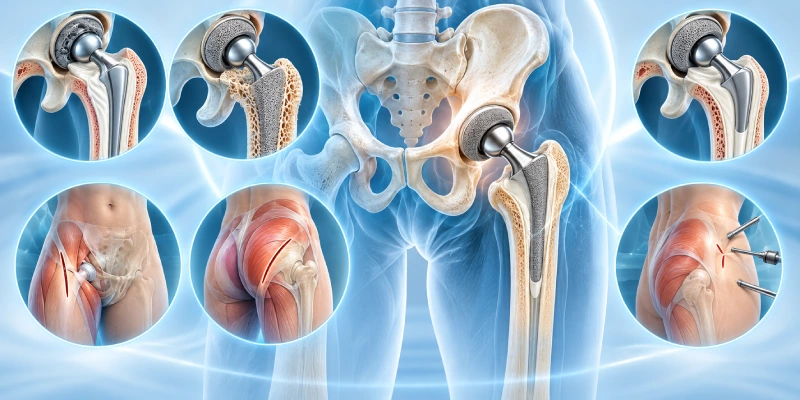
Types of Total Hip Replacement Surgery
Cemented
Uses bone cement to firmly anchor implants within the bone.
Cementless (Uncemented)
Uses porous surfaces, allowing natural bone growth around the implant.
Hybrid
Combines an uncemented socket with a cemented femoral stem.
Anterior
Accesses the joint from the front, sparing muscles for recovery.
Posterior
Accesses the joint from the back, offering excellent joint visibility.
Lateral
Accesses the joint from the side, minimising the risk of hip dislocation.
Minimally Invasive
Uses smaller incisions to reduce tissue damage and blood loss.
Quick View Of Surgical Options
| Type | What It Involves | Who It May Suit |
|---|---|---|
| Anterior | Front access with less muscle disruption. | Those prioritising muscle preservation. |
| Posterior | Back access with excellent joint visibility. | Patients requiring clear surgical access. |
| Lateral | Side access with lower dislocation risk. | Patients where stability is a priority. |
| Minimally Invasive | Smaller incisions with less tissue damage. | Those needing less invasive surgery. |
| Cemented | Uses bone cement to secure the implant. | Older adults or those with weaker bone. |
| Cementless | Allows bone to grow onto the implant surface. | Younger patients with good bone quality. |
| Hybrid | Combines cemented and cementless fixation methods. | Patients needing a combination of fixation techniques. |
| Robotic-Assisted | Uses navigation and robotic assistance for precise positioning. | Patients suitable for technology-assisted surgery. |
Step-by-Step Procedure of Total Hip Replacement
-
Step 1: Medical Evaluation
Your care team reviews your health, medical history, and imaging before surgery.
-
Step 2: Anaesthesia
You receive general or regional anaesthesia to keep you comfortable throughout the procedure.
-
Step 3: Positioning
The surgeon positions you on your side or back, depending on the chosen surgical approach.
-
Step 4: Incision
The surgeon makes an incision to access the hip joint through surrounding tissues.
-
Step 5: Dislocation
The femoral head is carefully moved out of the acetabulum to expose the joint.
-
Step 6: Removing Damaged Bone
The damaged femoral head and diseased cartilage are removed to prepare the joint.
-
Step 7: Preparing the Socket
The socket is reshaped before placing and securing the artificial metal cup.
-
Step 8: Inserting the New Ball and Stem
The surgeon prepares the femur, then inserts the stem and attaches the artificial ball.
-
Step 9: Testing and Closure
The surgeon tests the components for movement and stability before carefully closing the incision.
Risks & Safety Measures to Follow After Total Hip Replacement
Risks
- Joint dislocation
- Blood clots (deep vein thrombosis)
- Infection
- Persistent or increasing pain
- Delayed functional recovery
- New numbness or weakness
- Leg-length concerns
- Implant-related problems
Safety Tips
- Avoid bending beyond 90°
- Do not cross legs
- Avoid twisting and impact
- Sleep in recommended positions
- Use walking aids correctly
- Follow weight-bearing restrictions
- Keep wounds clean; take medicines
- Attend follow-ups; complete physiotherapy
Recovery Timeline After Total Hip Replacement
-
First Few Days
Stand and walk with assistance; most patients return home within one to three days.
-
2 To 4 Weeks
Walk short distances, reduce stronger pain medicines, and gradually transition away from walking aids.
-
6 To 12 Weeks
Resume driving, light work, and daily activities when cleared and comfortably mobile.
-
6 To 12 Months
Hip strength, mobility, and swelling continue improving as muscles and surrounding tissues fully recover.
From Pain to Progress: Real Success Stories
What Factors Determine Pricing for Total Hip Replacement
- Implant material and brand
- Surgical technology
- Hospital infrastructure and location
- Surgeon’s expertise
- Patient health and complications
- Type of surgical approach
- Hospital stay and room category
- Pre-surgery investigations
- Post-surgery rehabilitation
- Medication and follow-up care
Non-Surgical vs Surgical Total Hip Treatment: Cost Factors
| Cost Factor | Non-Surgical Treatment | Surgical Hemiarthroplasty |
|---|---|---|
| Initial Costs | Consultations, medicines, imaging | Surgery, implant, anaesthesia |
| Hospital Stay | Usually none | Admission and monitoring |
| Rehabilitation | Physiotherapy, symptom management | Physiotherapy, mobility training |
| Long-Term Costs | Ongoing medicines and therapy | Follow-ups, rehabilitation, future care |
Frequently Asked Questions
Does hip replacement cause permanent activity restrictions?
No. Most people return to walking, swimming, cycling, and everyday activities. High-impact movements may remain limited because they can increase wear, loosening, or injury risk.
Can you run or play sports after surgery?
No. High-impact activities are generally discouraged because repeated loading can increase implant wear. Swimming, cycling, walking, and other low-impact exercises are usually safer after recovery.
Can you cross your legs after hip replacement?
No, not initially. Bringing one leg across the other can increase dislocation risk during early healing. Your surgeon will advise when this position becomes safe.
Can you drive again after hip replacement?
Yes. Most people resume driving once strength, mobility, reaction time, and pain control have improved. You should also safely enter, exit, and control the vehicle.
Can you have sex after hip replacement?
Yes. You can usually resume intimacy when discomfort has settled, and movement feels comfortable. You may need to modify certain positions initially to avoid excessive bending, twisting, or pressure.
Is hip replacement surgery likely to fail?
No. Modern implants generally provide durable results, but complications can occur. Loosening, infection, dislocation, fracture, or wear may occasionally require further treatment or another procedure.
Can both hips be replaced if needed?
Yes. Both sides can be treated when disease affects each joint significantly. Procedures may occur separately or, in selected patients, during one operative session.
Can young people have a hip replacement?
Yes. It may be recommended when severe joint damage causes persistent pain and disability despite appropriate alternatives. Younger patients may require additional procedures later because implants have finite longevity.
Can children have routine hip replacement surgery?
No. It is uncommon during childhood because bones continue developing. Specialists usually consider joint-preserving treatments first, reserving replacement for exceptional cases involving severe irreversible damage.
Does osteoporosis prevent successful hip replacement?
No. Reduced bone density can affect implant choice, fixation, and fracture risk, but proper planning and treatment can enable successful outcomes in carefully selected patients.