
Shoulder Fracture Treatment Doctor in Jamshedpur
Home / Treatments / Shoulder / Shoulder Fracture
Leading orthopaedic doctor for treating shoulder fractures
12,000+ patients treated across orthopaedic care
14+ years of orthopaedic surgical experience
MS Orthopaedic, Gold Medalist
Fellowship in Arthroscopy and Sports Surgery
- Red Cross Bhawan, Pipe Line Road, near Old Court Road, Ambagan, Sakchi, Jamshedpur, Jharkhand 831001
Orthopaedic Treatments

What Is a Shoulder Fracture?
A partial or complete break in one of the three bones that make up your shoulder joint: the collarbone, the upper arm bone, or the shoulder blade.
Key Points To Know
| Aspect | Details |
|---|---|
| The Goal | Restore bone alignment, shoulder function and pain-free movement while promoting reliable healing. |
| Commonly Affected Bones | Clavicle, proximal humerus and scapula. |
| Common Causes | Falls, road traffic accidents, sports injuries and direct impact. |
| Treatment | May include immobilisation, medicines and physiotherapy, or surgical fixation when indicated. |
Before You Proceed, Know What Matters
Is a shoulder fracture the same as a collarbone fracture?
No. These injuries involve different bones around the shoulder region.
Can a shoulder fracture heal without surgery?
Yes. Stable injuries with acceptable alignment often recover successfully through nonoperative care.
Can you have a fracture if you can still move your arm?
Yes. Movement remains possible despite a break, especially with smaller or stable injuries.
Does a broken shoulder always cause loss of movement?
No. Restriction varies according to injury severity, swelling, pain, and healing progress.
Can an older person recover from a shoulder fracture?
Yes. Recovery depends on bone quality, overall health, injury pattern, and rehabilitation.
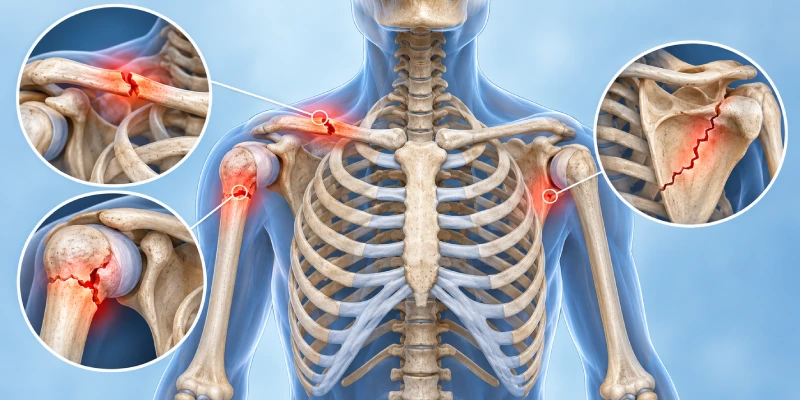
Types of Shoulder Fractures
Clavicle Fracture
A break in the collarbone, often caused by falls or direct impact.
Proximal Humerus Fracture
A break near the upper arm bone, commonly affecting older adults after falls.
Scapula Fracture
A rare shoulder blade injury, usually caused by high-energy trauma.
You May Need Shoulder Fracture Treatment if You Have
- Sudden pain
- Swelling and bruising
- Deformity
- Limited mobility
- Numbness or weakness
- Circulation changes
- Visible deformity
- Unstable fracture
- Joint involvement
- Delayed or failed healing
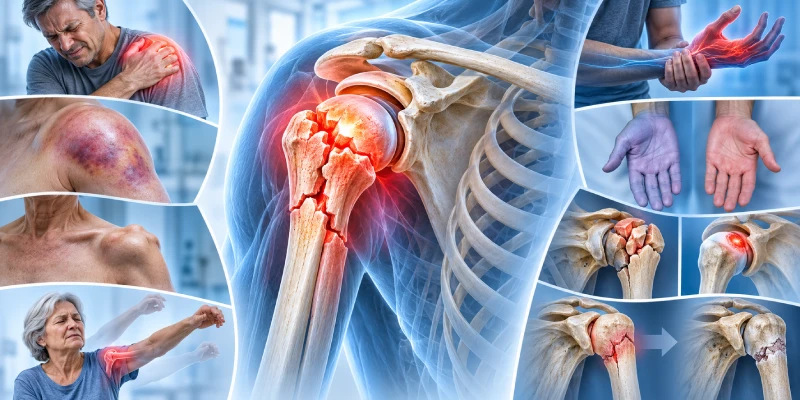
What Can Happen if a Shoulder Fracture Is Not Properly Treated?
Malunion
Nonunion
Post-traumatic arthritis
Permanent stiffness
Frozen shoulder
Nerve damage
Blood vessel damage
Persistent shoulder pain
Delayed union
Reduced shoulder strength
Altered shoulder mechanics
Difficulty returning to work, sports or daily activities
Diagnostic Tests Before Shoulder Fracture Treatment
- Physical Examination
- X-rays
- CT Scan
- MRI Scan
- Neurovascular Assessment
- Blood Tests
- ECG
- Preoperative Medical Evaluation
Types of Shoulder Fracture Treatment
Surgical Treatments
- Open Reduction and Internal Fixation (ORIF)
- Intramedullary Nailing
- Shoulder Replacement (Arthroplasty)
- Post-Surgery Rehabilitation
Non-Surgical Treatments
- Immobilisation
- Pain Management
- Bone Stimulation
- Physical Therapy
Step-by-Step Procedure of Shoulder Fracture Surgery
-
Step 1: Evaluation and Diagnosis
A physical exam checks for pain, swelling, bruising, and deformity; X-rays or CT scans locate the fracture.
-
Step 2: Non-Surgical Procedure
Stable fractures use slings, pain medication, and early elbow and wrist movement to prevent stiffness.
-
Step 3: Surgical Procedure
Displaced fractures require anaesthesia, realignment, fixation with plates or screws, and wound closure.
-
Step 4: Recovery and Rehabilitation
Sling protection, wound care, physiotherapy, and gradual strengthening support healing and shoulder function.
Risks & Safety Measures After Shoulder Fracture Treatment
Risks
- Frozen shoulder
- Malunion or non-union
- Infection or nerve injury
- Post-traumatic arthritis
- Persistent shoulder pain
- Reduced shoulder strength
- Implant irritation or failure
- Need for further treatment
Safety Tips
- Wear the sling as directed
- Sleep in a semi-upright position
- Apply wrapped ice for 10–15 minutes
- Avoid lifting, pushing, pulling, and driving
- Follow prescribed restrictions and medications
- Avoid forcing painful movements
- Attend follow-ups and imaging reviews
- Report warning signs; complete physiotherapy
Recovery Timeline After Shoulder Fracture Treatment
Non-Surgical Recovery
-
Weeks 1–4
Sling protection and gentle movements.
-
Weeks 5–8
Physiotherapy and gradual mobility exercises.
-
Weeks 9–12
Light strengthening and sling discontinuation.
-
3–6 Months
Bone healing and daily activities.
Surgical Recovery
-
Weeks 1–6
Wound care, sling, passive movements.
-
Weeks 7–12
Active movement and light strengthening.
-
3–6 Months
Daily activities and functional strengthening.
-
6–12 Months
Final recovery of shoulder function.
From Pain to Progress: Real Success Stories
What Factors Determine Pricing for Shoulder Fracture Treatment?
- Type of treatment
- Fracture severity and complexity
- Implants and hardware
- Surgeon’s expertise
- Hospital infrastructure
- Diagnostic investigations
- Anaesthesia requirements
- Post-operative rehabilitation
- Follow-up consultations
- Associated injuries or conditions
- Degree of displacement
- Hospital stay & Follow-up imaging
Non-Surgical vs Surgical Shoulder Fracture Treatment: Cost Factors
| Cost Factor | Non-Surgical | Surgical |
|---|---|---|
| Initial costs | Lower, with basic treatment and follow-ups | Higher, with surgery and specialised care |
| Facility & doctor fees | Usually lower | Includes operating-room and surgeon fees |
| Implants & hardware | Usually not required | May include plates, screws or joint components |
| Rehabilitation | May require fewer formal sessions | Usually requires structured rehabilitation |
| Follow-up care | Routine monitoring and X-rays | Closer monitoring and additional interventions may be needed |
| Recovery & productivity | Recovery may take longer with immobilisation | May allow earlier return to activity in selected cases |
Frequently Asked Questions
Does a shoulder fracture always cause severe pain?
No. Discomfort varies with the injury. Some people experience mild soreness, while others develop intense pain, swelling, tenderness, or difficulty using the affected arm.
Do swelling and bruising appear immediately after injury?
No. These changes may develop gradually over several hours. Their timing depends on tissue damage, bleeding under the skin, and injury severity.
Do most shoulder fractures need surgery?
No. Many stable breaks can heal with immobilisation, pain management, and rehabilitation. An operation is considered when alignment, stability, or joint function is significantly affected.
Does surgery always ensure faster shoulder recovery?
No. Recovery depends on injury severity, healing, rehabilitation, bone health, and overall health. An operation can restore alignment but does not guarantee a quicker return to normal activity.
Should you wear a sling all day after a shoulder fracture?
No. Wear it for the period your doctor recommends. Gentle movement is often introduced at the appropriate stage to prevent stiffness and support functional recovery.
Is heat better than ice after a shoulder injury?
No. Cold therapy is generally preferred during the early phase to reduce discomfort and swelling. Heat may help later if stiffness persists, depending on clinical advice.
Is physiotherapy needed only after shoulder surgery?
No. Structured exercises may also be needed after non-operative care to restore flexibility, strength, coordination, and everyday arm function once healing permits movement.
Can you know you have osteoporosis before a fracture?
Yes. Bone-density testing can identify reduced bone strength before a break occurs. Doctors may recommend assessment based on age, risk factors, previous injuries, or other health conditions.
Does smoking affect shoulder fracture healing?
Yes. Tobacco can reduce blood flow and interfere with bone-forming processes, potentially delaying union and increasing healing complications. Stopping smoking supports better recovery.
Can an improperly healed fracture be treated later?
Yes. Imaging can assess persistent deformity, pain, or restricted function. Depending on the problem, treatment can include rehabilitation or corrective surgery.