
Arthroscopic (Keyhole) Surgery in Jamshedpur
Home / Treatments / Sports & Arthroscopy / Arthroscopic (Keyhole) Surgery
Top orthopaedist with expertise in knee/shoulder arthroscopy
12,000+ patients treated across orthopaedic care
14+ years of orthopaedic surgical experience
MS Orthopaedic, Gold Medalist
Fellowship in Arthroscopy and Sports Surgery
- Red Cross Bhawan, Pipe Line Road, near Old Court Road, Ambagan, Sakchi, Jamshedpur, Jharkhand 831001
Orthopaedic Treatments

What Is Arthroscopic (Keyhole) Surgery?
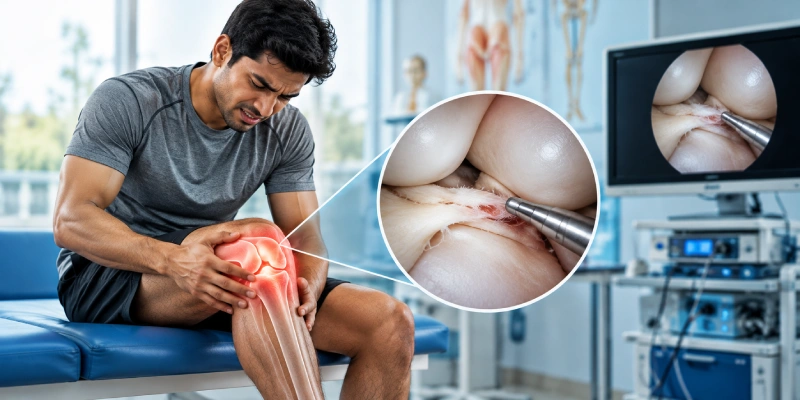
A minimally invasive procedure used to diagnose and treat problems inside a joint using a tiny camera and specialised instruments inserted through small cuts.
Key Points To Know
| Factor | Details |
|---|---|
| Small Incisions | Uses small openings for joint access. |
| Joint Access | Camera provides a clear joint view. |
| Treatment | Treats selected cartilage, meniscus, ligament or tendon problems. |
| Common Joints | Knee, shoulder, ankle, hip, elbow and wrist. |
| Anaesthesia | The type depends on the procedure and the patient. |
Need More Insights Before Committing? Read These
Is Arthroscopic Surgery Always Better Than Open Surgery?
No. Suitability depends on diagnosis, damage, joint and required procedure.
Is Arthroscopic Surgery Only Used For Sports Injuries?
No. It also treats selected cartilage, ligament, meniscus, and tendon problems.
Is Arthroscopic Surgery Painful?
Yes. Temporary discomfort and stiffness may occur during early recovery.
Can You Go Home The Same Day After Arthroscopy?
Yes. Many patients return home within hours after appropriate observation.
Does Keyhole Surgery Guarantee Faster Recovery?
No. Recovery depends on tissues treated and rehabilitation requirements.
You May Need Arthroscopic (Keyhole) Surgery if You Have
- Meniscus tears
- ACL or PCL injuries
- Rotator cuff tears
- Shoulder instability or recurrent dislocation
- Cartilage damage or loose bodies
- Femoroacetabular impingement (FAI)
- Synovitis
- Locked or catching joint
- Persistent symptoms despite conservative treatment
- Confirmed structural damage
- Sports injuries affecting functional performance
- Recurrent joint instability
- Significant movement restriction
- Persistent pain or swelling
Complications if Arthroscopic (Keyhole) Surgery Is Not Done?
Reduced mobility and daily function
Progressive muscle weakness
Worsening cartilage damage
Secondary joint damage
Recurrent catching or locking
More complex future treatment
Prolonged pain and functional limitations
Delayed return to sports
Recurrent joint inflammation
Reduced exercise tolerance
Progressive joint instability
Compensatory stress on other joints
Reduced movement confidence
Difficulty resuming previous activities
Increased reliance on pain relief
Diagnostic Tests Before Arthroscopic Surgery
Diagnostic Imaging
- MRI
- X-Rays
- CT Scan
- Ultrasound
Preoperative Medical & Blood Tests
- Complete Blood Count (CBC)
- Coagulation Studies (PT/PTT)
- Blood Glucose Test
- Electrolyte Panel
- Renal Function Studies
- Electrocardiogram (ECG)
- Chest X-Ray
- Physical Examination & Medical History
Types of Arthroscopic (Keyhole) Surgery
Knee
Treats selected meniscus tears, ACL injuries, loose fragments, and cartilage damage.
Shoulder
Treats rotator cuff tears, instability, impingement, frozen shoulder, and labral injuries.
Hip
Addresses impingement, labral tears, loose bodies, and inflamed joint tissue.
Ankle
Treats scar tissue, bone spurs, cartilage defects, and persistent ankle problems.
Wrist
Diagnoses and treats selected wrist pain, TFCC tears, and ganglion cysts.
Elbow
Removes loose fragments and treats stiffness, scar tissue, and selected joint problems.
Jaw (TMJ)
Treats selected jaw-joint disorders causing pain, stiffness, locking, or restricted movement.
Arthroscopic (Keyhole) Surgery Options at a Glance
| Types | What It Involves | Who It Suits |
|---|---|---|
| Knee & Shoulder | Repairing meniscus, ACL, rotator cuff, or labral tears. | Patients with sports injuries or persistent joint problems. |
| Hip & Ankle | Treating impingement, cartilage defects, scar tissue, or bone spurs. | Individuals experiencing catching, stiffness, or restricted movement. |
| Wrist & Elbow | Treating TFCC tears, loose fragments, stiffness, or selected cysts. | Those with persistent small-joint pain or movement limitations. |
| Jaw (TMJ) | Addressing joint pain, locking, stiffness, or restricted jaw movement. | Patients with selected temporomandibular joint disorders. |
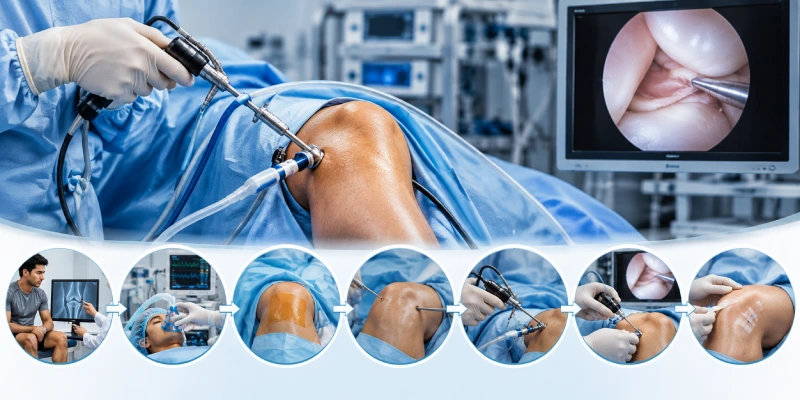
Step-by-Step Procedure of Arthroscopic (Keyhole) Surgery
-
Step 1: Pre-Procedure Evaluation and Preparation
Review medical history, imaging, medications, fasting instructions, and informed consent before surgery.
-
Step 2: Anaesthesia
Administer appropriate anaesthesia while continuously monitoring vital signs throughout the procedure.
-
Step 3: Positioning and Sterilisation
Position the affected joint securely and prepare surrounding skin using sterile techniques.
-
Step 4: Creating Small Incisions
Create tiny portals around the joint and introduce sterile fluid for visibility.
-
Step 5: Inserting the Camera
Insert the arthroscope to provide magnified, real-time views of internal joint structures.
-
Step 6: Diagnosis and Surgical Treatment
Use specialised instruments to repair, remove, trim, or reconstruct damaged joint structures.
-
Step 7: Closure and Dressing
Drain fluid, close small incisions, and apply appropriate dressings or protective supports.
Risks & Safety Measures After Arthroscopic (Keyhole) Surgery
Risks
- Infection
- Blood clots
- Bleeding or swelling
- Nerve or tissue injury
- Joint stiffness
- Temporary joint pain
- Bruising around incisions
- Blood-vessel injury
- Persistent symptoms
- Incomplete recovery
- Further treatment may become necessary
Safety Tips
- Manage pain and swelling
- Keep wounds clean and dry
- Use assistive devices properly
- Follow prescribed weight-bearing restrictions
- Follow prescribed physical therapy
- Elevate the operated limb when advised
- Follow medication instructions
- Avoid overexertion during recovery
- Attend scheduled follow-ups
- Report increasing pain or swelling promptly
- Seek advice for fever or wound discharge
Recovery Timeline After Arthroscopic (Keyhole) Surgery
-
Days 1–3: Initial Recovery
Swelling, bruising, and soreness peak; rest, ice, compression, elevation, and support help.
-
Days 4–7: Early Healing
Discomfort gradually decreases; gentle exercises and light movement support circulation and joint mobility.
-
Weeks 1–2: Walking and Desk Work
Many patients reduce crutch use and resume sedentary work as comfort and mobility improve.
-
Weeks 3–6: Strength and Mobility
Swelling improves, walking becomes easier, and structured physiotherapy restores strength and daily function.
-
Week 7 and Beyond: Sports and High-Impact Activities
Low-impact activities may resume earlier, while competitive sports depend on the procedure and tissue healing.
From Pain to Progress: Real Success Stories
What Factors Determine Pricing for Arthroscopic (Keyhole) Surgery?
- Joint & Procedure Type
- Surgeon’s Expertise & Fees
- Hospital & Infrastructure
- Condition Severity
- Surgical Complexity
- Implants & Consumables
- Arthroscopic Equipment
- Diagnostic Tests & Imaging
- Anaesthesia & Operating Time
- Hospital Stay
- Post-Operative Care & Physiotherapy
- Rehabilitation & Follow-Up Consultations
Arthroscopic vs Open Surgery: Cost Factors
| Cost Factor | Arthroscopic (Keyhole) | Open Procedure |
|---|---|---|
| Procedure | Small incisions with a camera and specialised instruments. | Larger incision for direct surgical access. |
| Equipment & Technology | Specialised camera, fluid system, and video equipment. | Conventional surgical instruments and equipment. |
| Anaesthesia | Regional or general anaesthesia, depending on procedure. | Anaesthesia depends on procedure and complexity. |
| Hospital Stay | Often performed as day surgery. | May require overnight or longer hospitalisation. |
| Implants & Consumables | Anchors, sutures, grafts, or specialised devices. | Plates, screws, sutures, grafts, or fixation devices. |
| Rehabilitation | Often shorter early rehabilitation for suitable procedures. | May require longer rehabilitation after greater tissue disruption. |
| Surgeon & Theatre Fees | Varies with expertise, complexity, and equipment. | Varies with expertise, complexity, and operating time. |
| Overall Recovery Costs | May involve lower indirect costs with faster recovery. | May involve higher indirect costs with longer recovery. |
Frequently Asked Questions
Is Keyhole Surgery Safe for Older Patients?
Yes. Age alone does not exclude suitability. Overall health, joint condition, medications, anaesthesia risks, and expected benefits should guide individual assessment.
Can Children Undergo Keyhole Surgery?
Yes. Selected young patients may benefit when appropriate. Decisions consider skeletal maturity, injury pattern, joint involved, and the child’s overall health.
Can Overweight Patients Have Keyhole Surgery?
Yes. Higher body weight does not automatically prevent treatment. Individual assessment considers medical conditions, technical requirements, anaesthesia risks, and expected recovery.
Can Keyhole Surgery Treat Severe Joint Injuries?
Yes. Selected complex injuries may be addressed using minimally invasive techniques, including certain ligament, cartilage, meniscus, or multi-structure problems.
Is Keyhole Surgery Only Used to Diagnose Joint Problems?
No. Surgeons can also repair, remove, trim, or reconstruct selected damaged tissues during the same procedure when clinically appropriate.
Is General Anaesthesia Always Needed for Keyhole Surgery?
No. Regional, spinal, or general techniques may be selected based on the operation, the joint involved, medical history, and the anaesthesia assessment.
Can You Walk Soon After Knee Keyhole Surgery?
Yes. Many patients begin supported walking relatively early, although weight-bearing depends on the procedure, repaired tissues, surgeon’s instructions, and individual recovery.
Does Keyhole Surgery Leave Large Scars?
No. Surgeons typically use small portal openings, leaving minimal skin marks. Their final appearance varies with healing, incision placement, skin type, and aftercare.
Can a Repaired Ligament Tear Again?
Yes. A reconstructed ligament can sustain another injury, particularly after premature loading, inadequate rehabilitation, or new trauma during sports or demanding activities.
Does Keyhole Surgery Prevent Future Joint Replacement?
No. It may address specific mechanical problems but cannot guarantee avoidance of replacement when progressive joint degeneration eventually becomes advanced.