
Knee Replacement Surgery in Jamshedpur
Home / Treatments / Knee / Knee Replacement
Performed by the leading knee replacement surgeon
12,000+ patients treated across orthopaedic care
14+ years of orthopaedic surgical experience
MS Orthopaedic, Gold Medalist
Fellowship in Arthroscopy and Sports Surgery
- Red Cross Bhawan, Pipe Line Road, near Old Court Road, Ambagan, Sakchi, Jamshedpur, Jharkhand 831001
Orthopaedic Treatments

What Is Knee Replacement Surgery?
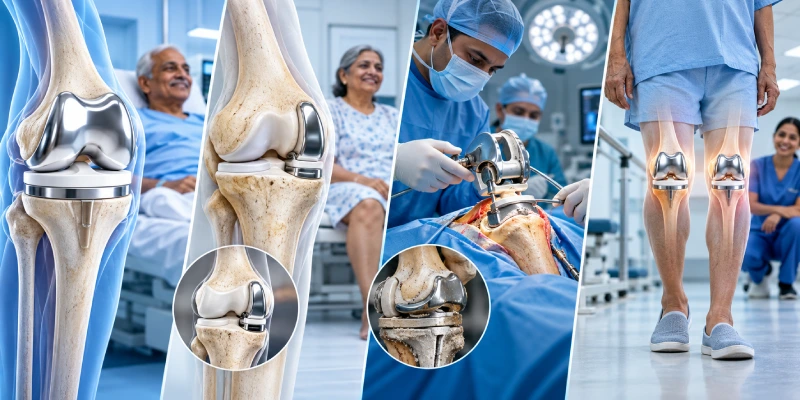
Also called Arthroplasty, it replaces damaged bone and cartilage in the knee joint with artificial metal and plastic implants to relieve severe pain and restore mobility.
Key Points To Know
| Aspect | Details |
|---|---|
| Procedure | Surgeons reshape the ends of the thigh bone (femur) and shin bone (tibia), then place smooth metal and plastic components. |
| Total vs. Partial | Total knee replacement replaces all three compartments of the knee, while partial replacement targets only the damaged section. |
| Primary Causes | Common causes include severe osteoarthritis, rheumatoid arthritis, and traumatic joint injury. |
Ready To Commit? Learn These First
Is knee replacement surgery only for older people?
No. Younger patients may also qualify based on symptoms and joint damage.
Is knee replacement surgery very painful?
No. Modern pain management techniques can make recovery more comfortable.
How long does knee replacement recovery actually take?
It varies. Many patients gradually resume daily activities within 6–12 weeks.
Will a replaced knee feel artificial or unnatural?
No. Modern implants are designed to support natural-feeling movement and function.
Is knee replacement surgery really a last resort?
No. Surgery may be considered when other treatments no longer help.
You May Need Knee Replacement If You Have
- Severe arthritis affecting your knee function
- Persistent pain despite non-surgical treatment
- Difficulty walking or managing daily activities
- Severe pain even while resting
- Persistent swelling despite appropriate treatment
- Progressive deformity affecting your walking pattern
- Difficulty fully straightening your knee
- Age and lifestyle suitable for replacement

Complications if Knee Replacement Is Not Done?
Progressive knee deformity
Weakening of surrounding leg muscles
Increasing joint stiffness
Strain on other joints
Greater risk of falls
Reduced physical activity
Possible weight gain
More challenging rehabilitation later
Diagnostic Tests Before Knee Replacement Surgery
- Weight-bearing X-ray
- MRI & CT scan
- Complete blood count
- Blood sugar testing
- Liver function tests
- Kidney function tests
- Electrocardiogram (ECG)
- Chest X-ray
- Urinalysis
- Urinary infection screening
- Knee range-of-motion assessment
- Joint stability assessment
- Deformity assessment
- Infection screening
Types of Knee Replacement (KR) Surgery
Total
Replaces damaged surfaces across the knee, usually for advanced arthritis affecting multiple compartments and causing significant pain and functional limitations.
Partial
Replaces only the damaged compartment while preserving healthy bone, cartilage, and ligaments. It may allow a smaller incision and quicker recovery.
Revision
Replaces a previous knee implant when problems such as loosening, infection, wear, or persistent complications affect its function.
Bilateral
Treats severe damage in both knees, either during one operation or through separate staged procedures based on individual health and surgical considerations.
Knee Replacement Options at a Glance
| Type Of (KR) | What It Involves | Who It May Suit |
|---|---|---|
| Total | Removes damaged bone and cartilage and resurfaces the knee joint with artificial metal and plastic components. | People with severe arthritis or extensive damage affecting the knee joint. |
| Partial | Replaces only the damaged part of the knee while preserving healthy bone and tissue. | People whose damage is limited to one compartment of the knee. |
| Revision | Removes and replaces a previous knee implant that has become worn, loose, damaged, or problematic. | People experiencing complications or failure of an earlier knee replacement. |
| Bilateral | Replaces both knees, either during the same operation or through separate staged procedures. | People with significant damage affecting both knees who are medically suitable for surgery. |
Step-by-Step Procedure Of Knee Replacement Surgery
-
Preparation and Anaesthesia
The patient receives appropriate anaesthesia before surgery, while the leg is cleaned with an antiseptic solution and covered with sterile drapes.
-
Incision and Joint Exposure
The surgeon makes an incision at the front of the knee and gently moves the kneecap aside to expose the damaged joint surfaces.
-
Resurfacing the Knee
Damaged cartilage and bone are carefully removed from the femur and tibia, while the underside of the kneecap may be resurfaced when necessary.
-
Implant Placement and Testing
The surgeon tests temporary components for proper size, alignment, stability, and movement before securely placing permanent metal and plastic components within the knee.
-
Closing the Surgical Site
After confirming proper movement and alignment, the surgeon repositions the kneecap, closes the tissues and skin, and applies a sterile dressing to the incision.
Risks & Safety Measures to Follow After Knee Replacement Surgery
Risks
- Blood clots after reduced mobility
- Superficial or deep joint infection
- Knee stiffness from scar tissue
- Implant loosening or component wear
- Nerve or blood vessel injury
Safety Measures To Follow Post-Surgery
- Remove walkway fall hazards
- Avoid twisting or crossing legs
- Take prescribed medicines correctly
- Keep incision clean; monitor infection signs
- Complete prescribed physiotherapy exercises
Recovery Timeline After Knee Replacement Surgery
-
Week 1 to Week 2: Acute Recovery
Patients usually begin walking with assistance within 24 hours, manage swelling and pain, start gentle exercises, and gradually regain basic mobility.
-
Weeks 3 to 6: Regaining Independence
Walking aids are gradually reduced as strength improves, while patients resume light household activities, desk work, and other everyday tasks as advised.
-
Weeks 6 to 12: Strength and Mobility
Physical therapy focuses on rebuilding leg strength, improving balance and flexibility, increasing walking distance, and gradually returning to suitable low-impact activities.
-
Months 3 to 12: Long-Term Healing
Most patients return to routine low-impact activities, while residual stiffness or swelling gradually improves and strength, mobility, and overall knee function continue developing.
From Pain to Progress: Real Success Stories
What Factors Determine Pricing For Knee Replacement
- Type of replacement required
- Implant type selected for surgery
- Surgeon’s professional and surgical fees
- Hospital and operating-room charges
- Pre-surgery tests and medical evaluation
- Hospital stay and post-operative care
- Physiotherapy and rehabilitation requirements
- Treatment of any surgical complications
Partial vs Total Knee Replacement: Cost Factors
| Cost Factor | Partial Knee Replacement | Total Knee Replacement |
|---|---|---|
| Extent of Replacement | One damaged knee compartment | Multiple damaged joint surfaces |
| Implant Requirements | Fewer implant components | More implant components |
| Surgical Complexity | Generally less extensive | More extensive procedure |
| Hospital Stay | May require shorter stay | May require longer stay |
| Rehabilitation | Recovery may be shorter | Rehabilitation may take longer |
| Pre- and Post-Op Care | Tests, medicines and physiotherapy | Tests, medicines and physiotherapy |
| Overall Cost | As per individual requirements | As per individual requirements |
Frequently Asked Questions
Is knee replacement surgery really successful?
Yes. Most patients experience significant pain relief, improved mobility, and better ability to perform everyday activities after appropriate rehabilitation.
Is knee replacement surgery considered very risky?
No. Serious complications are uncommon, although risks such as infection, blood clots, and implant-related problems can occur.
Is bending the knee difficult after replacement surgery?
No. Most patients regain useful movement with regular rehabilitation, although the final range varies by individual.
Can a failed knee replacement be repaired successfully?
Yes. Revision surgery can address problems such as loosening, wear, infection, or other implant-related complications.
Can you drive normally after knee replacement surgery?
Yes. Many patients resume driving once strength, movement, reaction time, and medical clearance allow safe vehicle control.
Do knee replacement implants last only ten years?
No. Modern implants can function for many years, with longevity influenced by activity, implant type, and individual factors.
Can the body reject a knee replacement implant?
No. True rejection is not typical, although infection, loosening, wear, or other complications may affect implant performance.
Can both knees be replaced during the same surgery?
Yes. Bilateral replacement can sometimes be performed together, depending on overall health and surgical assessment.
Can people with diabetes or hypertension undergo replacement?
Yes. These conditions do not automatically prevent surgery when appropriately controlled and medically assessed beforehand.
Should physical activity be avoided after knee replacement?
No. Suitable low-impact activities are generally encouraged, while high-impact activities may need to be restricted to protect the implant.