
Knee Fracture Doctor in Jamshedpur
Home / Treatments / Knee / Knee Fracture
Trusted orthopaedic doctor/surgeon for knee fractures
12,000+ patients treated across orthopaedic care
14+ years of orthopaedic surgical experience
MS Orthopaedic, Gold Medalist
Fellowship in Arthroscopy and Sports Surgery
- Red Cross Bhawan, Pipe Line Road, near Old Court Road, Ambagan, Sakchi, Jamshedpur, Jharkhand 831001
Orthopaedic Treatments

What Is a Knee Fracture?
A break in one of the bones forming the knee joint—the patella (kneecap), distal femur (thighbone), or proximal tibia (shinbone)—typically caused by a severe impact, fall, or sudden muscle contraction.
Key Points To Know
| Metric | India Context |
|---|---|
| Road Accidents | Major cause of knee joint trauma |
| Surgical Cases | High-impact injuries requiring surgery |
| Patella Fractures | Transverse fractures linked to dashboard impact |
| Tibial Fractures | Proportion involving the proximal tibia |
| High-Risk Age | Younger, active population most affected |
Ready to Commit? Learn These First
Is a knee fracture always treated with surgery?
No. Depending on injury severity, doctors may recommend bracing, casting, or surgery.
Is a knee fracture very painful?
Yes. Significant discomfort is common, especially during movement or weight-bearing activities.
How long does knee fracture recovery actually take?
Healing typically requires 3 to 6 months; complete recovery may take close to a year.
Will a fractured knee feel normal after treatment?
Yes. Many patients regain mobility, strength, stability, and everyday function after rehabilitation.
Is knee fracture surgery really necessary?
No. Surgery becomes necessary mainly for displaced, unstable, or joint-involving injuries.
Types of Knee Fractures
Patellar (Kneecap)
Breaks in the kneecap (or patella) are often caused by direct impact from falls, accidents, or dashboard collisions.
Distal Femur
Breaks affecting the lower thighbone just above the knee joint, commonly resulting from significant trauma or weakened bones.
Proximal Tibia (Tibial Plateau)
Breaks in the upper shinbone forming the knee’s weight-bearing surface, potentially affecting joint stability and alignment.
Avulsion
Small bone fragments pulled away from the main bone when a tendon or ligament experiences sudden, forceful tension.
You May Need Knee Fracture Treatment if You Have
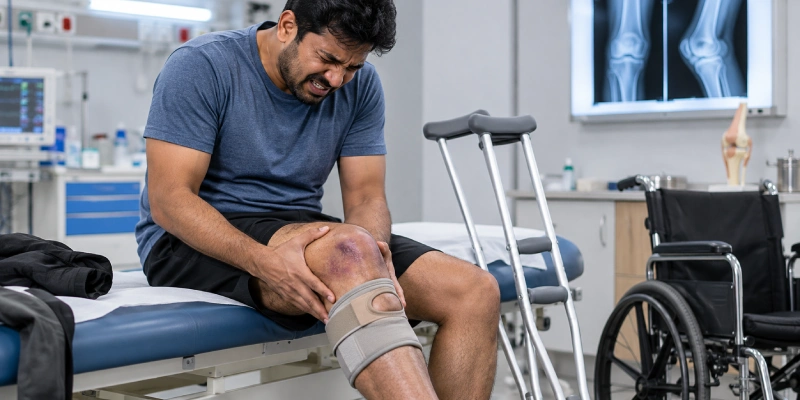
- Severe pain
- Swelling and bruising
- Inability to move
- No weight-bearing
- Visible deformity
- Tenderness over the injured bone
- Persistent symptoms after initial injury care
- Pain after a road accident or fall
Complications if Knee Fracture Is Not Treated?
Nonunion or Malunion
Delayed union
Infection
Vascular and nerve damage
Post-traumatic arthritis
Permanent stiffness and loss of motion
Muscle atrophy and weakness
Chronic disability
Persistent knee deformity
Chronic knee pain
Reduced weight-bearing ability
Difficulty returning to normal activities
Diagnostic Tests Before Knee Fracture Treatment
Clinical Examination
- Physical examination
- Knee range-of-motion assessment
- Joint stability assessment
- Circulation and nerve function assessment
Imaging Tests
- X-ray
- CT scan
- MRI scan
- Fracture alignment assessment
Types of Knee Fracture Treatment
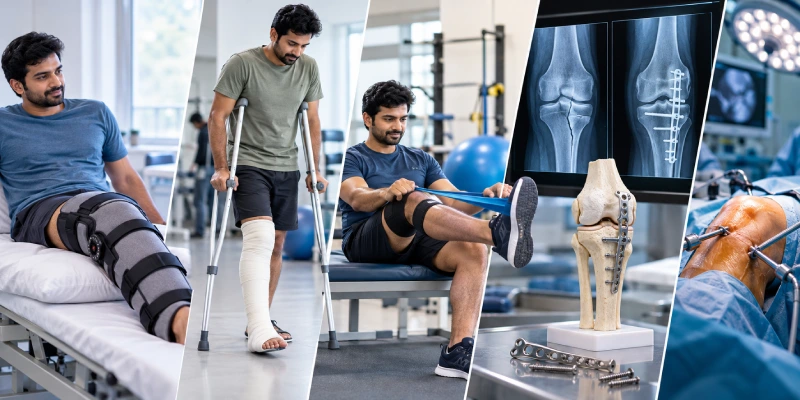
Non-Surgical Treatment
- Cast Immobilisation
- Splinting
- Knee Bracing
- Weight Restriction
- Pain Management
- Physical Therapy
Surgical Treatment
- Internal Fixation
- Open Reduction Internal Fixation (ORIF)
- External Fixation
- Total/Partial Knee Replacement
Quick View of Treatment Options
| Type | What It Involves | Who It May Suit |
|---|---|---|
| Non-Surgical | Immobilisation, weight restriction, pain management, and physical therapy | Stable, non-displaced fractures |
| Surgical | Internal fixation, external fixation, or joint replacement | Displaced, unstable, complex, or severe fractures |
Step-by-Step Procedure of Knee Fracture Treatment
-
Step 1: Diagnosis and Evaluation
Clinical examination and imaging identify the fracture location, severity, alignment, joint involvement, and associated knee injuries.
-
Step 2: Non-Surgical (Conservative Care)
Stable fractures may require immobilisation, restricted weight-bearing, pain management, and monitoring while the bone heals naturally.
-
Step 3: Surgical
Displaced or unstable fractures may require reduction and fixation using plates, screws, wires, pins, or other implants.
-
Step 4: Rehabilitation and Recovery
Structured rehabilitation restores knee movement, muscle strength, stability, and weight-bearing ability while supporting a gradual return to daily activities.
Risks & Safety Measures to Follow After Knee Fracture Treatment
Risks
- Watch for signs of infection
- Recognise symptoms of blood clots
- Report persistent knee stiffness promptly
- Monitor implants for potential failure
- Watch for delayed bone healing
- Report numbness or circulation changes
Safety Tips
- Use mobility aids correctly
- Follow weight-bearing restrictions
- Keep wounds clean & monitor infection
- Complete daily physiotherapy exercises
- Avoid twisting or overloading
- Elevate your leg regularly
Recovery Timeline After Knee Fracture Treatment
-
Initial Phase (Weeks 0–6)
Focus on immobilisation, swelling control, pain management, and protecting the healing knee.
-
Early Mobility & Rehabilitation (Weeks 6–12)
Begin guided weight-bearing and structured physiotherapy as healing progresses under medical supervision.
-
Strengthening Phase (Months 3–6)
Gradually rebuild muscle strength, balance, stability, walking ability, and overall knee function.
-
Long-Term Recovery (Months 6–12)
Resume daily and low-impact activities, while returning to strenuous activities after specialist clearance.
From Pain to Progress: Real Success Stories
What Factors Determine Pricing for Knee Fracture Treatment
- Location and severity of the fracture
- Type of fracture treatment required
- Fixation devices or implants required
- Surgeon’s professional and surgical fees
- Hospital and operating-room charges
- Pre-surgery tests and medical evaluation
- Hospital stay and post-operative care
- Physiotherapy and rehabilitation requirements
Non-Surgical vs Surgical Knee Fracture Treatment: Cost Factors
| Cost Factor | Non-Surgical Treatment | Surgical Treatment |
|---|---|---|
| Treatment Approach | Immobilisation and rehabilitation | Fracture reduction and fixation |
| Procedure | Usually no major operation | Surgical procedure |
| Hospital Stay | Usually not required | May require hospital admission |
| Rehabilitation | Based on healing and mobility | Structured post-operative rehabilitation |
| Pre- and Post-Treatment Care | Consultation, medicines and follow-up | Tests, medicines and physiotherapy |
| Overall Cost | As per individual requirements | As per individual requirements |
Frequently Asked Questions
Can you walk even if your knee is fractured?
Yes. Certain breaks still permit limited weight-bearing, although pain and swelling may restrict movement. Examination and imaging are needed to determine injury severity.
Can a knee fracture occur without visible deformity?
Yes. Some injuries cause swelling, bruising, or tenderness without changing the knee's external appearance. Internal bone damage can still affect stability and movement.
Can an X-ray miss a knee fracture?
Yes. Small cracks or stress injuries may be hard to detect at first. MRI or CT may be recommended when symptoms persist despite normal X-ray findings.
Do knee fractures only happen after major accidents?
No. Falls, sports injuries, twisting incidents, and low-impact trauma can also cause breaks, particularly when bone strength is reduced.
Does surgery help a knee fracture heal faster?
Not necessarily. Its primary purpose is to restore alignment and stability when needed. Bone repair still follows its natural biological timeline after fixation.
Do plates and screws need removal after fracture surgery?
Usually not. Fixation devices can remain permanently unless they cause persistent irritation, infection, movement problems, or another specific complication.
Can ice heal a knee fracture?
No. Ice can reduce swelling and ease discomfort after an injury, but it cannot repair broken bone or restore structural stability.
Will your knee feel normal once the brace or cast comes off?
Not immediately. Weakness, stiffness, and reduced movement are common initially. Progressive exercises and rehabilitation help restore strength, flexibility, and function.
Can you return to sports as soon as the fracture heals?
Not always. Strength, movement, balance, and functional recovery also matter. A gradual progression helps reduce the risk of reinjury.
Will you never kneel comfortably after a kneecap fracture?
No. Tenderness around the front of the joint may persist initially, but many people gradually regain comfortable kneeling with appropriate rehabilitation.