


It doesn’t begin with an injury you remember. It begins with hesitation. A pause before lifting your arm. A slight wince when reaching back. A growing awareness that your shoulder no longer obeys you the way it used to.
Frozen shoulder creeps in quietly, tightens steadily, and then refuses to leave.
Most people delay care
They assume painkillers will settle it. They wait for mornings when stiffness feels lighter. That waiting changes the disease itself.
Early evaluation by an orthopaedic doctor in Jamshedpur can interrupt the process before inflammation locks your shoulder into months—or years—of restricted movement.
Why frozen shoulder is not a pain problem—but a structural one
Frozen shoulder, medically known as adhesive capsulitis, is not caused by weak muscles or ageing joints. It is a disease of the shoulder capsule.
Inflammation thickens the capsule, reduces its elasticity, and gradually shrinks the joint space. Movement becomes restricted not only because of pain, but also because the joint cannot physically glide.
Pain marks the early stage. Stiffness defines the damage.
Causes of frozen shoulder in adults
- Prolonged shoulder inactivity after a minor injury
- Diabetes and metabolic disorders that impair tissue healing
- Thyroid imbalance affecting connective tissue behaviour
- Long hours of static work with minimal shoulder movement
- Immobilisation after surgery or trauma
Painkillers suppress symptoms. They do not reverse capsular tightening. Treatment must address the capsule itself.
Why waiting does not protect you—it traps you
Outdated advice once encouraged patients to “wait it out.” Modern orthopaedics has moved on. Waiting allows inflammation to convert into fibrosis. Fibrosis stiffens tissue permanently and slows recovery.
Many people experiment with home remedies for frozen shoulders—heat packs, oils, and self-stretching routines. These methods provide comfort, not correction. The joint continues to tighten silently.
This is where timely care under Dr Prashant Arya, an orthopaedic doctor in Jamshedpur, changes outcomes instead of merely managing pain.
What happens when frozen shoulder is misdiagnosed—or missed
Frozen shoulder frequently masquerades as rotator cuff strain, tendonitis, or neck-related pain. Misdiagnosis locks patients into ineffective treatments while capsular fibrosis progresses unchecked.
Clinical consequences of missed diagnosis
| Missed factor | Resulting impact |
| Unrecognised capsular inflammation | Progressive joint volume loss |
| Incorrect phase identification | Ineffective physiotherapy |
| Delayed imaging | Missed the early intervention window |
| Symptom-only management | Prolonged functional disability |
An accurate diagnosis early preserves shoulder mechanics. Guesswork prolongs damage.
When pain reduces but movement collapses
Frozen shoulder progresses through three clinically recognised phases. Each phase demands a different treatment strategy. Treating all phases the same delays recovery.
Clinical progression of frozen shoulder
| Phase | Patient experience | Biological change | Correct response |
| Freezing | Increasing pain, disturbed sleep | Active synovial inflammation | Pain modulation + guided therapy |
| Frozen | Pain settles, stiffness peaks | Capsular thickening and fibrosis | Interventional care |
| Thawing | Gradual return of motion | Capsular remodelling | Structured rehabilitation |
Ignoring phase-specific care allows stiffness to harden.
Is physiotherapy enough? Only when it is precise
Physiotherapy for frozen shoulder works when clinicians tailor it to the disease phase. Random exercises during active inflammation increase pain and reinforce protective muscle guarding.
What effective shoulder stiffness treatment actually involves
- Phase-specific joint mobilisation
- Pain-calibrated range restoration
- Image-guided pain control when required
- Strength rebuilding only after mobility improves
Precision restores movement. Generic routines prolong suffering.
When conservative care stops being enough
If stiffness persists beyond six to eight weeks despite structured therapy, conservative care alone no longer works. Structural restriction demands structural correction under an experienced orthopaedic doctor in Jamshedpur.
Frozen shoulder pain relief methods that correct the pathology
- Ultrasound-guided intra-articular steroid injections
- Hydrodilatation to gently expand the contracted capsule
- Targeted anti-inflammatory protocols
- Closely supervised rehabilitation progression
These interventions treat the disease—not just the discomfort.
The hidden toll frozen shoulder takes on daily life
Frozen shoulders affect far more than arm movement. Interrupted sleep lowers pain tolerance. Guarded posture strains the neck and upper back. Productivity drops because every task requires caution.
Impacts patients often underestimate
- Poor sleep amplifies inflammation
- Compensatory movements overload the spine
- Chronic discomfort delays decisive treatment
- Functional decline becomes falsely “normal”
Early intervention restores rhythm—not just range of motion.
What qualifies as advanced treatment—and who truly needs it
Advanced treatment does not mean last resort. It means not losing time when time stops working. Frozen shoulder turns resistant when inflammation reshapes the capsule into a rigid, low-elastic structure. At that stage, exercises and painkillers stop addressing the problem. Waiting longer does not make recovery safer—it makes it slower.
Advanced frozen shoulder treatments exist to interrupt prolonged disability, not to escalate care unnecessarily. Doctors move forward only when conservative treatment fails to restore motion within a predictable window. The objective never changes: reclaim function before stiffness hardens into permanence.
How clinicians decide the next step
| Response to care | Clinical signal | Next step | Expected outcome |
| Early diagnosis | Reversible inflammation | Targeted rehab + medication | Rapid improvement |
| Persistent stiffness | Capsular tightening | Injection or hydrodilatation | Recovery within weeks |
| Resistant cases | Established fibrosis | Arthroscopic capsular release | Fast functional return |
Micro-scenario
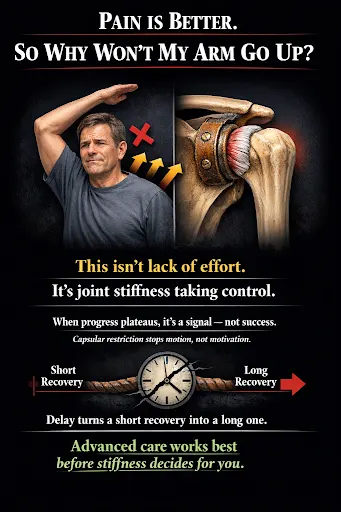
A patient completes weeks of therapy, pain reduces, but overhead reach never returns. This plateau signals capsular restriction—not effort failure. Timely intervention here restores motion. Delay turns a short recovery into a prolonged one.
Advanced care works best before stiffness decides for you.
Under Dr Prashant Arya, an orthopaedic doctor in Jamshedpur, minimally invasive procedures prioritise safety, speed, and sustained mobility.
How long does frozen shoulder last—and why that question misleads
Patients frequently ask ‘how long does frozen shoulder last?’ Untreated cases may persist 18–36 months. Early intervention shortens recovery dramatically.
Time does not heal capsular fibrosis. Correct treatment does. That reality drives patients to seek the best orthopaedic doctor for frozen shoulders, not reassurance.
Why exercises alone fail to restore true shoulder function
Exercises do not fail because movement is wrong. They fail because timing is ignored. Shoulder joint mobility exercises only support recovery once active inflammation has settled. When patients stretch aggressively during the inflammatory phase, they provoke micro-tears within an already irritated capsule. Pain increases, guarding worsens, and stiffness deepens rather than releases.
Unsupervised routines often create the illusion of progress while quietly reinforcing restriction. Movement without diagnosis treats symptoms, not structure. That distinction decides recovery speed.
What actually restores movement—safely and permanently
- Clinician-guided mobility progression that respects disease phase and tissue response
- Pain-calibrated stretching that expands the capsule without triggering inflammation
- Strength rebuilding only after range returns, preventing compensatory strain
Structure—not intensity—separates recovery from relapse. When movement follows medical logic rather than guesswork, the shoulder regains function rather than cycling through pain again.
Why do patients keep searching without relief
Many people explore multiple centres and even consider Frozen shoulder treatment in Kolkata because improvement feels elusive. Geography does not decide outcomes. Diagnosis, timing, and execution do.
Care under a skilled orthopaedic doctor in Jamshedpur aligns treatment with real-world demands—work schedules, recovery timelines, and long-term shoulder use.
Act before stiffness decides for you
Frozen shoulder remains reversible—but only with timely, phase-appropriate care. Modern orthopaedics reject passive waiting. If stiffness or restricted movement has become routine, action is no longer optional.
Consult Dr Prashant Arya, an orthopaedic doctor in Jamshedpur, and reclaim shoulder function before delay turns a treatable condition into prolonged disability.
People Also Ask
How to speed up recovery from frozen shoulder?
Early diagnosis, pain control, and supervised physiotherapy are the fastest ways to speed up frozen shoulder recovery. Delays allow stiffness to worsen and prolong healing.
What is the permanent cure for frozen shoulder?
Frozen shoulder has no instant cure, but it resolves completely with timely treatment, guided physiotherapy, and gradual restoration of shoulder movement.
What can an orthopaedic doctor do for a frozen shoulder?
An orthopaedic doctor confirms the diagnosis, reduces pain and inflammation, prescribes targeted physiotherapy, and offers injections or procedures if motion does not improve.
What’s the best treatment for a frozen shoulder?
The best treatment is structured physiotherapy supported by pain management. Resistant cases may require injections or minimally invasive interventions.

Leave A Comment