
Hip Fracture Surgery in Jamshedpur
Home / Treatments / Hip / Hip Fracture
Trusted orthopaedic doctor for hip fracture surgery
12,000+ patients treated across orthopaedic care
14+ years of orthopaedic surgical experience
MS Orthopaedic, Gold Medalist
Fellowship in Arthroscopy and Sports Surgery
- Red Cross Bhawan, Pipe Line Road, near Old Court Road, Ambagan, Sakchi, Jamshedpur, Jharkhand 831001
Orthopaedic Treatments

What Is a Hip Fracture?
A serious break in the upper part of the thigh bone (femur) near the hip joint, commonly caused by falls in older adults.
Key Points To Know
| Metric | Clinical Context | Data |
|---|---|---|
| Common Cause | Falls and direct trauma | Major mechanism |
| Higher-Risk Group | Elderly, particularly those with weakened bones | Increased risk |
| Common Location | Femoral neck and trochanteric regions | Upper femur |
| Treatment Priority | Early assessment and appropriate intervention | Urgent care |
Considering Surgery? Learn These First
Is a hip fracture always treated with surgery?
Usually. Most cases require operative treatment, depending on overall health.
Is a hip fracture very painful?
Yes. Severe discomfort commonly occurs, especially during movement or weight-bearing.
How long does hip fracture recovery actually take?
6 months to 1 year for near-complete functional recovery; bone healing takes 10–12 weeks.
Will a fractured hip feel normal after treatment?
Not always. Recovery varies according to severity, health, mobility, and rehabilitation.
Is hip fracture surgery really necessary?
Yes, usually. Surgery stabilises the injury or replaces damaged joint structures.
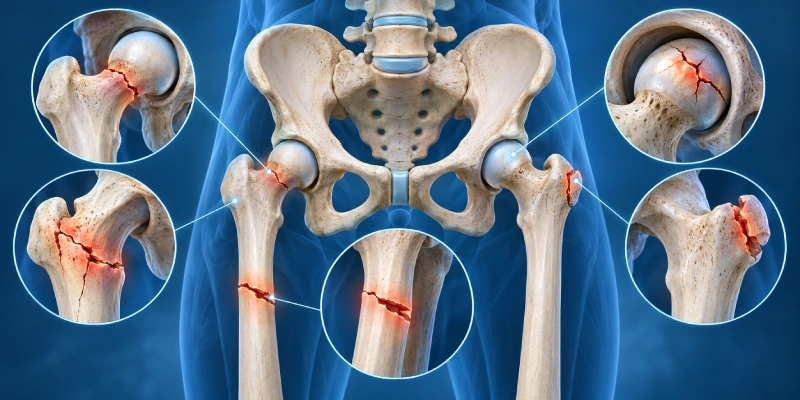
Types of Hip Fractures
Femoral Neck (or Broken Hip)
Neck of femur fractures occur within the capsule and commonly affect elderly patients.
Intertrochanteric
Occurs between the greater and lesser trochanters and is often seen in elderly patients with hip fractures.
Subtrochanteric
Occurs just below the lesser trochanter and experiences substantial mechanical stress during movement.
Femoral Head
Rarely involves the hip’s rounded ball and often accompanies hip dislocation.
Greater Trochanter
Involves the prominent outer upper femur and may occur alongside larger fracture patterns.
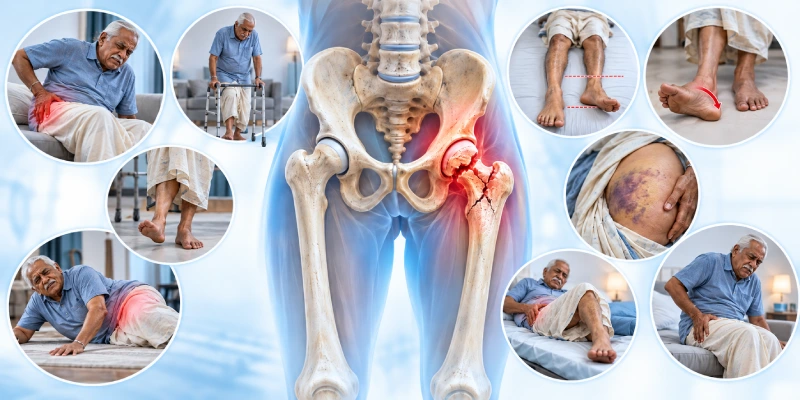
You May Need Hip Fracture Surgery if You Have
- Severe hip or groin pain
- Difficulty standing or walking
- Inability to bear weight
- Leg appearing shorter
- Leg turning outward
- Hip swelling and bruising
- Pain after a fall or direct impact
- Difficulty moving the affected leg
- Persistent pain following an injury
Complications if Hip Fracture Is Not Treated?
Deep vein thrombosis or pulmonary embolism
Pneumonia and other chest infections
Pressure ulcers or bedsores
UTIs & increased risk of mortality
Severe muscle loss and weakness
Malunion or non-union of the fracture
Chronic pain and permanent disability
Loss of mobility and independence
Avascular necrosis of the femoral head
Reduced ability to perform daily activities
Diagnostic Tests Before Hip Fracture Surgery
Clinical Assessment
- Physical examination
- Neurovascular assessment
- Pre-operative medical assessment
- Evaluation of overall surgical fitness
Imaging Tests
- X-rays
- MRI
- CT scan
- Fracture displacement assessment
Blood Tests
- Complete Blood Count (CBC)
- Basic Metabolic Panel
- Blood Sugar
- Blood Clotting Tests
Heart, Chest & Urine Tests
- Electrocardiogram (ECG/EKG)
- Chest Imaging
- Urine Examination
Types of Hip Fracture Surgery
Open Reduction and Internal Fixation (ORIF)
Realigns broken bone pieces and secures them using screws, pins, plates, or rods.
Sliding Hip Screw (Dynamic Hip Screw)
Uses a specialised screw and plate to stabilise and compress the fracture.
Intramedullary Nail
Uses a metal rod inside the thighbone, commonly for unstable or subtrochanteric fractures.
Partial Hip Replacement (Hemiarthroplasty)
Replaces the femoral head while preserving the natural pelvic socket.
Total Hip Replacement
Replaces both the femoral head and hip socket with artificial prosthetic components.
Repair with Hardware
Uses screws and plates or a nail to stabilise the broken femur.
Quick View Of Treatment Options
| Type | What It Involves | Who It May Suit |
|---|---|---|
| ORIF | Bone realignment and fixation | Selected fractures |
| Sliding Hip Screw | Screw-and-plate fixation | Suitable fractures |
| Intramedullary Nail | Intramedullary fracture stabilisation | Unstable or lower fractures |
| Partial Hip Replacement | Femoral head replacement | Selected patients |
| Total Hip Replacement | Femoral head and socket replacement | Selected patients |
| Repair with Hardware | Screw, plate, or nail fixation | Suitable fractures |
Step-by-Step Procedure of Hip Fracture Treatment
-
Step 1: Diagnosis and Evaluation
Physical examination and imaging confirm the fracture and assess its location and severity.
-
Step 2: Pre-Surgical Preparation
Medical evaluation, pain control, antibiotics, and clot prevention prepare patients for surgery.
-
Step 3: Anaesthesia Administration
The team administers spinal or general anaesthesia based on the planned surgical approach.
-
Step 4: Surgical Intervention
The surgeon selects fixation, partial replacement, or total replacement based on fracture characteristics.
-
Step 5: Post-Surgical Recovery and Rehabilitation
Early therapy, assistive devices, home adjustments, and follow-up support recovery after surgery.
Risks & Safety Measures to Follow After Hip Fracture Surgery
Risks
- Blood clots in legs or lungs
- Surgical, urinary, or chest infections
- Temporary confusion after surgery
- Pressure sores from prolonged immobility
- Implant loosening, shifting, or failure
- Delayed fracture healing
- New numbness or weakness
- Difficulty bearing weight
- Wound healing problems
- Scheduled follow-up assessments
Safety Tips
- Follow prescribed weight-bearing restrictions carefully
- Avoid crossing legs or twisting hips
- Keep home pathways clear and safe
- Take prescribed medications exactly as directed
- Begin supervised movement and exercises early
- Use prescribed walking support correctly
- Keep the surgical wound clean
- Complete physical therapy exercises regularly
Recovery Timeline After Hip Fracture Surgery
-
Days 1 to 3
Physical therapy begins, helping patients stand or walk during their hospital stay.
-
Weeks 2 to 6
Walking aids gradually reduce as stability improves, with home exercises continuing.
-
Weeks 6 to 12
Light daily activities resume, and driving may be possible around six weeks if cleared.
-
Months 3 to 6
Bone healing progresses while strength and endurance training advances.
-
Months 6 to 12
Near-full recovery is expected, with continued improvement toward normal daily routines.
From Pain to Progress: Real Success Stories
What Factors Determine Pricing for Hip Fracture Treatment
- Location and severity of the fracture
- Fracture displacement and complexity
- Type of treatment required
- Fixation devices or implants required
- Hemi or total hip replacement requirements
- Surgeon’s professional and surgical fees
- Hospital and operating-room charges
- Pre-surgery tests and medical evaluation
- Hospital stay and post-operative care
- Physiotherapy and rehabilitation requirements
Non-Surgical vs Surgical Hip Fracture Treatment: Cost Factors
| Cost Factor | Non-Surgical Treatment | Surgical Treatment |
|---|---|---|
| Initial Costs | Lower upfront costs without surgery or implants | Higher costs for surgery, implants, anaesthesia, and surgical teams |
| Hospital Stay | Costs increase with prolonged inpatient care | Delays beyond 48 hours can increase overall costs |
| Rehabilitation | May require prolonged nursing or assisted care | Requires post-operative physiotherapy and rehabilitation |
| Long-Term Costs | Immobility may increase nursing and assisted-care expenses | Rehabilitation adds post-discharge costs but supports mobility recovery |
Frequently Asked Questions
Do 95% of hip fractures occur due to falls?
Yes. Falls are the most common cause, particularly in older adults, although other factors such as high-impact trauma can also cause them.
Can a 90-year-old survive a broken femur?
Yes. Survival is possible, but advanced age increases the risk of complications, making prompt assessment and appropriate treatment important.
What are the 5 R's of fracture management?
Recognition identifies the injury, resuscitation stabilises the patient, reduction realigns the bone, retention maintains alignment, and rehabilitation restores function.
Is a hip fracture worse than a hip replacement?
Yes. It is generally more dangerous and has worse outcomes than a planned hip replacement because of the associated trauma and medical risks.
What is the life expectancy after a hip fracture without surgery?
It can decrease substantially, particularly in older adults. Studies report approximately 70% to 75% mortality within one year among elderly patients who remain untreated.
How long does it take for a hip fracture to heal in an 80-year-old?
Initial bone healing after surgery generally takes about 10 to 12 weeks, while functional recovery may take 6 months to a year.
Can a fracture heal in 20 days?
No. Complete healing and restoration of structural strength generally take much longer, although early repair processes are already underway during this period.
Will the bone ever be the same after a fracture?
Yes. Once fully healed, it can regain its original strength and structure. It does not normally remain permanently thicker or stronger than before the injury.
What are signs of poor bone healing?
Persistent pain, swelling, tenderness, or instability around the injury beyond the expected recovery period may indicate delayed healing and require medical evaluation.
What happens if a bone never heals?
It is called a nonunion, meaning the broken ends fail to join properly. In some cases, abnormal movement can create a condition called a pseudoarthrosis, or “false joint.”