
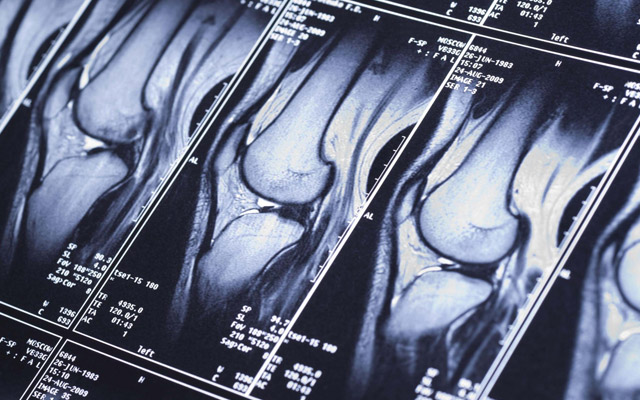
An MRI showing a tear does not automatically mean surgery is required.
Treatment depends on symptoms, knee stability, and functional limitation—not just imaging. Many patients improve with non-surgical treatment for a meniscus tear, especially when there is no locking or instability.
If you are considering knee ligament repair in Jamshedpur, a proper clinical evaluation by Dr Prashant Arya ensures that surgery is recommended only when truly necessary—not just because a scan shows a tear.
Today’s blog explains why an MRI showing a tear does not always mean surgery is necessary.
Why MRI Reports Often Lead to Confusion
MRI is highly sensitive. It detects even minor structural changes—some of which may not be clinically important.
This can lead to overdiagnosis, in which findings appear serious but do not match the symptoms. In fact, two people with the same MRI may need completely different treatments.
Common patient assumptions:
- “Tear means damage”
- “Damage means surgery”
- “Surgery is urgent”
Reality:
- Many tears are stable and symptom-free
- Some are age-related changes
- Not all tears affect function
This is why patients often ask: Is surgery necessary for every meniscus tear? Answer: No.
Clinical evaluation is essential before considering knee ligament repair in Jamshedpur, especially under the guidance of Dr Prashant Arya.
What a “Tear” Actually Means in the Knee
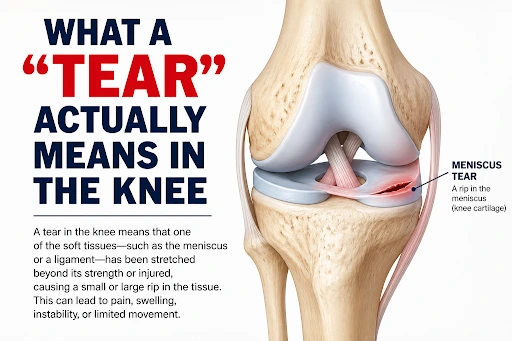
A “tear” in the knee refers to damage in structures like the meniscus or ligaments, but it does not always mean severe injury or the need for surgery.
Many tears are small, stable, or age-related and may not cause symptoms or affect knee function. Treatment depends on pain, stability, and movement—not just MRI findings.
1. Meniscus Tears (Most Common)
The meniscus acts as a cushion inside the knee.
Types:
- Small/stable tears
- Large/unstable tears
Meniscus tear treatment depends on size, location, and symptoms. Many cases of knee meniscus tear treatment do not require surgery.
Why Some Tears Never Cause Problems?
Not all tears interfere with function. Some occur in areas with limited nerve supply, meaning they may not cause pain. Others remain stable and do not worsen over time.
This is why many MRI findings are clinically silent.
- Ligament Injuries
Ligaments control knee stability.
- Partial injury → often treated conservatively
- Complete tear → may require surgery
A ligament tear in the knee is not always treated surgically in the early stages.
3. Degenerative vs Traumatic Tears
Degenerative tears are caused by the gradual wear and ageing of knee tissues, while traumatic tears result from sudden injury, often during sports or accidents. Degenerative tears are usually managed with physiotherapy and conservative care, whereas traumatic tears may require more active treatment depending on severity and symptoms.
Type | Cause | Treatment Approach |
Degenerative | Age-related wear | Conservative |
| Traumatic | Sports/injury | Case-dependent |
Many degenerative cases respond to MRI meniscus tear treatment without surgery
MRI vs Symptoms: What Matters More?
MRI shows structure. Symptoms show function.
Symptoms that matter:
- Pain while bending the knee
- Swelling after a knee injury
- Reduced mobility
Step-by-Step: How Doctors Actually Decide Knee Ligament Treatment
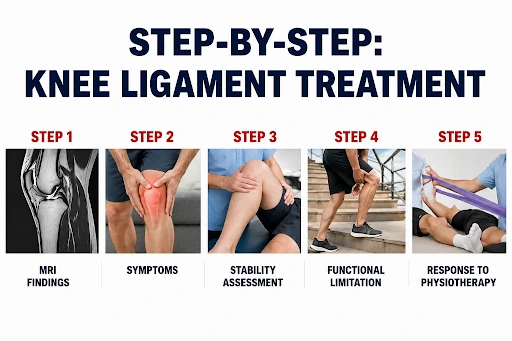
Step 1: MRI findings
The type, size, and location of the tear are assessed to understand whether it is likely to be stable or mechanically problematic.
Step 2: Symptoms
Pain, swelling, locking, or instability are evaluated to see if the MRI finding is actually causing functional issues.
Step 3: Stability assessment
Clinical tests determine whether the knee joint is stable or at risk of giving way during movement.
Step 4: Functional limitation
The impact on daily activities—walking, bending, climbing stairs—is considered more important than imaging alone.
Step 5: Response to physiotherapy
Improvement with structured rehabilitation often indicates that surgery may not be required. Surgery is recommended only when multiple clinical factors align—not based on MRI alone.
In practice, this structured evaluation is what specialists like Dr Prashant Arya use before advising knee ligament repair in Jamshedpur, ensuring treatment decisions are precise and necessary.
Red Flags That Indicate Knee Ligament Surgery
- Knee locking
- Repeated giving way
- Inability to fully bend or straighten
- Persistent swelling
Surgery is recommended only when multiple clinical factors align—not based on MRI alone.
With over 12,000 patients treated, Dr Prashant Arya follows this structured decision-making process to determine whether knee ligament repair in Jamshedpur is necessary—or avoidable.
When Knee Ligament Surgery Can Be Avoided
You may NOT need surgery if:
- No knee locking symptoms
- o knee instability or giving way
- Pain is manageable
- Mobility is preserved
Non-Surgical Treatment Options
- Physiotherapy for knee ligament injury
- Progressive strengthening (quadriceps, hamstrings, hip muscles)
- Activity modification and structured rehabilitation
These form the foundation of non-surgical treatment for a meniscus tear, where many patients achieve meaningful improvement without surgery.
What Improves Outcomes Without Knee Ligament Surgery
- Consistent, supervised rehabilitation
- Improved muscle strength and joint control
- Better movement patterns and load distribution
- Pain reduction and functional recovery are the primary goals
- In many degenerative cases, physiotherapy outcomes can be comparable to surgery
Strong, well-conditioned muscles help stabilise the knee and reduce stress on injured structures.
When Knee Ligament Surgery Becomes Necessary
- Knee locking or catching
- Persistent instability
- restricted knee movement
- Symptoms not improving
If conservative care fails, Dr Prashant Arya evaluates whether knee ligament repair in Jamshedpur will provide functional improvement rather than just structural correction.
Surgical Options Explained (Simple & Clear)
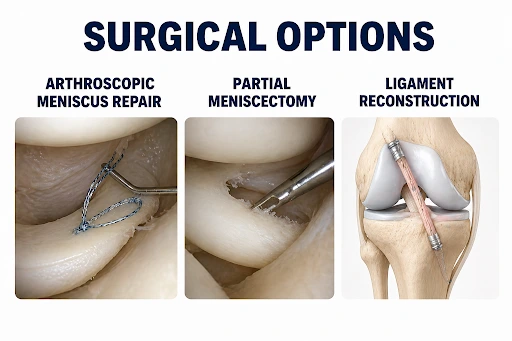
Arthroscopic Meniscus Repair
- Minimally invasive
- Preserves tissue
- Faster recovery
Used in arthroscopic meniscus repair.
Partial Meniscectomy
- Removes the damaged part
- Quick relief
Known as a partial meniscectomy.
Ligament Reconstruction
- Restores stability
- Advanced techniques
- Done by a knee arthroscopy surgeon
Includes:
- Ligament reconstruction surgery
- Minimally invasive knee surgery
Important Balance
Avoiding unnecessary surgery is important—but delaying required surgery can worsen joint damage.
Goal of Knee Ligament Surgery
- Restore stability
- Prevent long-term damage
- Enable normal activity
Recovery Timeline (Simplified)
Phase | Timeline | Goal |
Early | 1–3 weeks | Mobility |
Mid | 4–8 weeks | Strength |
| Late | 3–6 months | Full function |
What Affects Recovery
- Age and fitness
- Type of injury
- Rehab consistency
- Joint condition
Proper rehab is crucial for proper recovery after arthroscopy.
Real-Life Example (Why MRI Alone Misleads)
- Case 1: A patient with an MRI-confirmed tear but no instability recovered fully with physiotherapy.
- Case 2: Another with locking and instability required surgery and regained function post-recovery.
Why Second Opinions Matter
Many patients are advised to undergo surgery immediately after an MRI. A second opinion often reveals that conservative treatment is possible—helping avoid unnecessary procedures.
Quick Comparison: Surgery vs Non-Surgery
Factor | Non-Surgical | Surgical |
Pain | Mild–moderate | Persistent |
Stability | Stable | Unstable |
| Movement | Preserved | Restricted |
| Goal | Avoid surgery | Restore function |
When Should You See an Orthopaedic Specialist?
Seek evaluation if you notice:
- Persistent pain
- Locking
- Instability
- Swelling
Early vs Late Consultation
Early evaluation helps prevent worsening. Delays can turn manageable conditions into complex ones.
Common Mistakes After an MRI
- Assuming surgery is the only option
- Ignoring mild symptoms
- Delaying expert evaluation
- Self-treatment without guidance
Final Verdict: Treat the Patient, Not Just the MRI
If your MRI shows a tear, don’t rush into surgery. A structured evaluation can help you make the right decision.
Consult Dr Prashant Arya, a trusted specialist in knee ligament repair in Jamshedpur, for accurate diagnosis and personalised treatment.
- A gold medalist orthopaedic surgeon with a fellowship in Arthroscopy and Sports Surgery
- Over 8 years of experience in treating knee and hip disorders, sports injuries, and trauma,
- Strong focus on precise, evidence-based care.
Prior appointment recommended. Book a private session today.
People Also Ask
Can you walk normally with a knee tear?
Yes, many people can walk normally, especially with small or stable tears. Walking ability alone does not indicate severity or the need for surgery.
Do all knee tears show symptoms immediately after injury?
No. Some tears remain asymptomatic initially and may only cause discomfort later. This is why imaging findings and symptoms don’t always match.
Is it safe to exercise with a knee tear?
In many cases, yes—with guided physiotherapy. Controlled strengthening exercises help stabilise the joint and can reduce symptoms without worsening the injury.
Can lifestyle changes help manage a knee tear without surgery?
Yes. Activity modification, weight management, and avoiding high-impact movements can significantly reduce stress on the knee and improve recovery outcomes.
Are MRI reports always accurate in predicting treatment outcomes?
No. MRI shows structural changes, but cannot predict how the knee will function or respond to treatment. Clinical evaluation remains essential for decision-making.
Can a knee tear come back after successful treatment?
Yes. Re-injury is possible, especially without proper rehabilitation or return-to-activity planning. Long-term strength and joint control are key to prevention.
Does age affect how a knee tear is treated?
Yes. Younger patients with traumatic injuries may need different approaches compared to older individuals with degenerative tears, who often respond well to conservative care.