

Shoulder pain is everywhere today. Laptop work, gym overload, bad sleep posture, weekend sports. But here’s the catch: not all shoulder pain means the same thing.
When that pain starts tightening its grip and your shoulder loses movement day by day, it may be more than just a simple strain. Frozen shoulder often begins quietly, then gradually restricts motion until even basic movements feel like a task.
If the shoulder feels tighter every week and everyday tasks become difficult, it may be time to consider frozen shoulder treatment in Jamshedpur with Dr Prashant Arya, a trusted orthopaedic doctor in Jamshedpur who evaluates shoulder problems with precise clinical assessment.
Why “all shoulder pain” is not the same problem
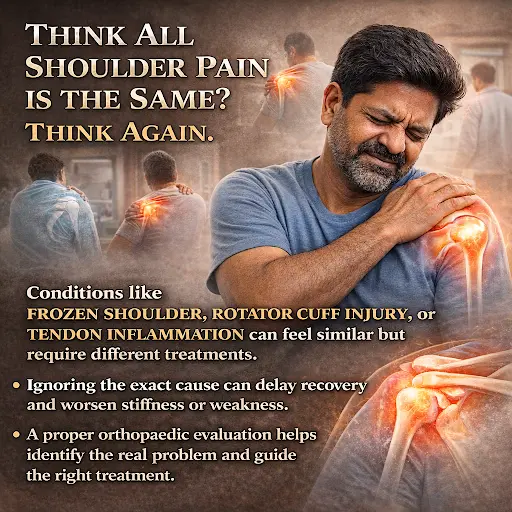
Most shoulder pain is caused by strain, tendon irritation, or muscle injury.
Frozen shoulder is different because stiffness gradually blocks joint movement. The key difference lies in how much you can move your arm.
Pain in the shoulder can arise from several structures, including muscles, tendons, ligaments, and even the neck. Many people assume every shoulder problem is the same. That assumption delays proper diagnosis.
A strain might hurt when you lift a bag. Frozen shoulder gradually turns simple actions like combing hair or reaching a shelf into a struggle.
The trick is recognising the pattern early.
What is frozen shoulder (adhesive capsulitis)?
The one-line definition patients actually understand
Frozen shoulder (adhesive capsulitis) is a condition in which the shoulder joint capsule thickens and tightens, leading to severe stiffness and restricted movement over time.
Why is it called “frozen” (stiffness drives more stiffness)
In adhesive capsulitis, the capsule surrounding the shoulder joint becomes inflamed and tight. Scar-like tissue forms, and movement gradually decreases.
Typical frozen shoulder symptoms include:
- Shoulder stiffness and pain that worsens slowly
- Difficulty reaching overhead or behind the back
- Shoulder pain at night that causes sleep disturbance
- Shoulder pain with limited range of motion
What does “normal shoulder pain” usually mean?
Most shoulder pain is caused by muscle strain, tendon irritation, rotator cuff injury, or posture-related stress. Movement is painful but usually still possible.
Overuse/strain (desk work, gym, lifting kids)
Repeated activity can irritate shoulder muscles.
Common signs:
- Localized soreness
- Pain after activity
- Movement possible but uncomfortable
Tendinitis/bursitis/impingement (pain mainly on certain moves)
In shoulder impingement vs frozen shoulder, impingement pain occurs when lifting the arm overhead.
Typical features:
- Pain during certain movements
- Relief at rest
- Full range of motion is usually preserved
Rotator cuff injury (pain + weakness pattern)
A torn tendon causes weakness and pain. When comparing a rotator cuff tear vs frozen shoulder, patients can usually move the shoulder with assistance, but strength is reduced.
Neck-related pain (radiating pain/tingling)
Sometimes the shoulder is innocent. Neck problems may cause:
- Pain radiating down the arm
- Tingling or numbness
- Neck stiffness along with shoulder discomfort
The fastest way to tell the difference (the movement test)
Active range of motion vs passive range of motion
Active movement means you lift the arm yourself. Passive movement means someone else moves your arm for you. In normal injuries, passive movement remains possible.
If you can’t move it even with help → think frozen shoulder
When the joint capsule tightens, even assisted movement becomes restricted. That classic sign strongly points to a frozen shoulder.
If movement is possible but painful/weak → think tendon/rotator cuff pattern
If another person can move the arm further than you can, the problem likely involves tendons or muscles rather than the joint capsule.
Symptom comparison (quick scan section people love)
Frozen shoulder develops gradually with increasing stiffness, while normal shoulder pain usually appears suddenly after activity or injury.
Frozen shoulder symptom pattern (stiffness-first progression + night pain)
- Gradual onset
- Severe stiffness
- Shoulder pain at night
- Difficulty lifting the arm overhead
“Normal” shoulder pain pattern (activity-related, position-triggered)
- Pain after activity
- Sharp pain with certain movements
- Relief with rest
Difference table (Frozen vs Normal)
| Feature | Frozen Shoulder | Normal Shoulder Pain |
| Movement | Severely restricted | Mostly preserved |
| Onset | Gradual | Often sudden |
| Night pain | Very common | Occasional |
| Passive movement | Limited | Usually possible |
| Recovery | Slow stages | Faster with rest |
Stages of frozen shoulder and how long each lasts
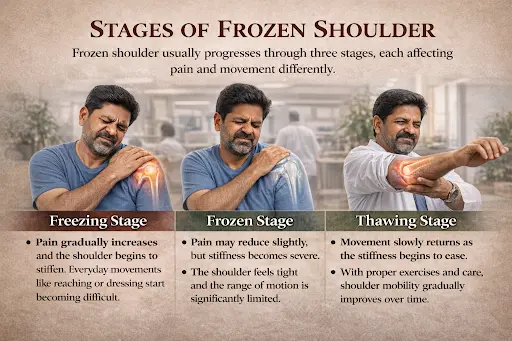
- Freezing stage: Pain increases, and stiffness begins to develop. Movement becomes progressively difficult.
- Frozen stage: Pain may reduce slightly, but stiffness becomes severe. Daily activities become restricted.
- Thawing stage: Gradual return of movement occurs. Recovery may take 6–24 months.
Causes and risk factors (who is more likely to get it?)
Diabetes and thyroid issues
People with diabetes are significantly more prone to diabetes frozen shoulder. Studies show the condition occurs more frequently in diabetic individuals due to connective tissue changes.
After injury/surgery/immobilisation
Long periods of shoulder inactivity can trigger stiffness.
Examples include:
- Shoulder fracture
- Post-surgery immobilisation
- Arm in a sling for weeks
Age group most affected
Frozen shoulder is most common between 40 and 60 years of age, particularly in individuals with metabolic conditions.
When is shoulder pain not “normal”? (red flags)
ER-now symptoms
- Chest tightness
- Breathlessness
- Sweating or dizziness
These symptoms may indicate cardiac problems.
Same-week doctor visit triggers
- Fever with shoulder pain
- Redness or swelling
- Visible deformity
- Arm numbness or weakness
Persistent stiffness also warrants early evaluation.
How doctors confirm the diagnosis
Diagnosis of frozen shoulder mainly depends on clinical examination and movement assessment.
What happens in the clinical shoulder exam (ROM check)
The doctor evaluates:
- Active arm movement
- Passive arm movement
- Pain pattern during motion
Do you need X-ray/MRI?
In many cases, diagnosis is clinical. Imaging may be used to rule out other conditions, such as:
- Rotator cuff tear
- Arthritis
- Bone injury
Treatment options (step-by-step ladder)
Pain control + keep it moving
Medication and controlled movement help prevent worsening stiffness. Early treatment can shorten recovery time.
Physiotherapy and mobility exercises
Frozen shoulder treatment physiotherapy exercises include:
- Pendulum exercises
- Wall climbing stretches
- Shoulder rotation drills
Injections (when considered)
Steroid injections may be recommended when pain severely restricts physiotherapy progress. They help reduce inflammation inside the joint capsule.
Procedures/surgery (rare, but mention to cover intent)
Rarely, procedures such as capsular release or manipulation under anaesthesia may be considered if conservative treatment fails.
Patients seeking frozen shoulder treatment in Jamshedpur from Dr Prashant Arya often benefit from early physiotherapy and expert guidance before surgery becomes necessary.
What you can do at home (safe do’s and don’ts)
Heat vs ice, sleep positioning, and activity modification
Helpful measures include:
- Warm compress before stretching
- Sleeping on the unaffected side
- Avoiding sudden heavy lifting
Avoid these mistakes
- Completely immobilising the arm
- Performing aggressive stretches
- Random deep massage on a painful shoulder
These habits can aggravate inflammation.
Who should seek medical evaluation early?
- Persistent stiffness: may signal developing frozen shoulder, not just routine strain
- Night pain worsening: a classic frozen shoulder pattern that shouldn’t be ignored
- Cannot lift the arm even with help (active vs passive movement): suggests joint capsule restriction, not simple pain
If these signs show up, early evaluation helps prevent long-term stiffness and delayed recovery.
People Also Ask
Can frozen shoulder heal on its own?
Yes, it can eventually improve, but recovery may take 1–2 years without treatment.
How to know if it’s a frozen shoulder or a rotator cuff injury?
Frozen shoulder limits both active and passive movement, while rotator cuff injuries mainly affect strength and active movement.
Is frozen shoulder common in diabetes?
Yes. Diabetes-related frozen shoulder occurs more frequently because metabolic changes affect connective tissues.
How long does recovery take?
Recovery varies from 6 months to 2 years, depending on the treatment and severity.
Should one stop gym or workouts?
Heavy overhead workouts should be avoided until pain improves and mobility returns.
Which exercises are safe to start?
Gentle pendulum movements and wall-climbing stretches are usually safe starter exercises for physiotherapy exercises in frozen shoulder treatment.
Does frozen shoulder always require surgery?
No. Most cases improve with physiotherapy, medication, and gradual mobility restoration.
When to see a doctor?
Consult a specialist if shoulder stiffness worsens over weeks or if daily activities like dressing and combing hair become difficult.
Here’s a Recap
Shoulder pain is common. Shoulder stiffness that keeps increasing is not.
Frozen shoulder slowly locks the joint, slowing down everyday life. The key warning signs are progressive stiffness, night pain, and shoulder pain with limited range of motion.
If stiffness keeps rising week after week, do not guess the diagnosis.
Seek expert evaluation for frozen shoulder treatment with Dr Prashant Arya, a trusted orthopaedic doctor in Jamshedpur.
Schedule your appointment today.